Corporate foundation funding in NYC: pre-proposal checklist
I have spent enough years working alongside executive directors, board chairs, and program managers across the five boroughs to know that conversations about corporate foundation funding almost always begin in the wrong place. We talk about narrative.
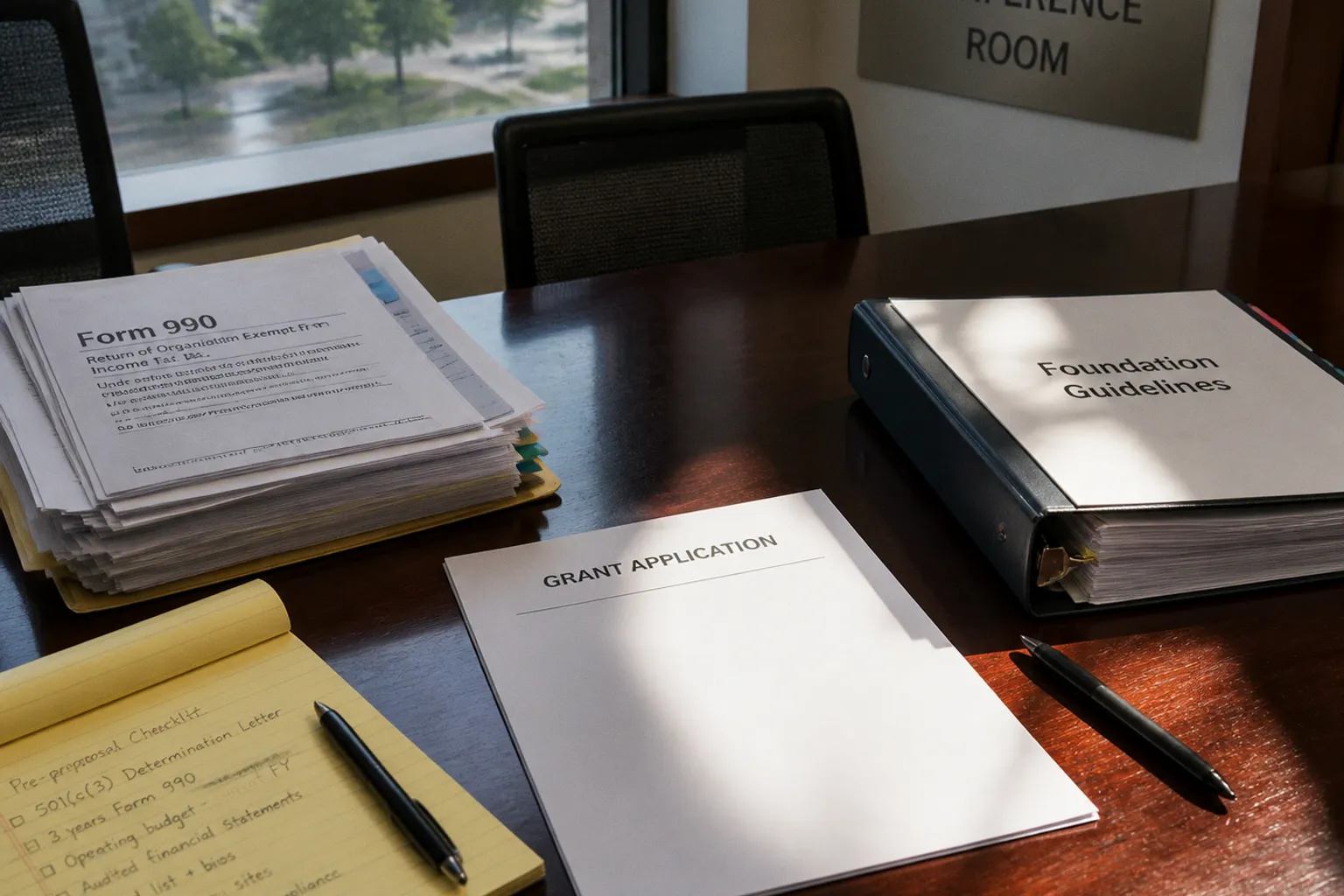
Why preparation, not persuasion, decides who gets funded
We talk about relationships. Increasingly, we talk about AI-assisted drafting tools and whether they can shorten the path to a check. What we rarely talk about — at least not until the first wave of rejections arrives — is the unglamorous infrastructure that determines whether a New York City nonprofit is even legible to a corporate grantmaker.
That infrastructure is built long before the proposal is opened. It is built out of legal status, financial documentation, governance, program clarity, and the operational discipline to answer a funder's questions without scrambling through old files. A strong story still matters. So does a compelling case for support. But neither can compensate for an organization that cannot clearly establish who it is, what it does, where it operates, and whether it can responsibly manage grant funds.
This is the part of the process that many organizations treat as administrative cleanup. In practice, it is part of fundraising strategy. The pre-proposal work determines which opportunities are realistic, which documents can be produced quickly, and whether a funder sees a young organization with promise or an organization that has not yet built the systems to support growth.
A corporate foundation usually has to confirm that it can legally and practically fund your organization before it has a reason to spend time on your mission statement.
That is why a pre-proposal checklist belongs at the front of the process rather than at the back. If you are a 501(c)(3) operating in New York City, or on your way to becoming one, the work begins with understanding the difference between federal tax exemption, state charitable registration, and a funder's own eligibility rules. Those are related questions, but they are not the same question.
The two regulatory layers every NYC nonprofit must understand
When I sit down with a new client and assess whether the organization is ready to pursue corporate foundation funding, I am not looking only at the latest draft proposal. I am looking for evidence that the organization has cleared two distinct regulatory layers and can document that status consistently.
The first layer is federal tax-exempt status under Section 501(c)(3) of the Internal Revenue Code. The IRS Determination Letter confirms that status and is one of the core documents many funders request during due diligence. It establishes the organization's federal tax position and, for grantmakers that fund public charities directly, helps answer the threshold question of whether a grant is permissible.
A Determination Letter is not a substitute for a compelling program or a functioning organization. It is also not a universal guarantee of eligibility. Some funders impose additional requirements related to the age of the organization, its public charity status, its geographic footprint, or the type of work it conducts. Others may allow applications from organizations using a fiscal sponsor, provided the arrangement meets their rules. The letter is foundational, but it is one piece of the eligibility picture.
The second layer is state-level registration with the New York State Attorney General's Charities Bureau. Organizations that are required to register because they solicit charitable contributions or otherwise fall within New York's charitable registration rules generally must maintain that registration and file the state's annual financial report, Form CHAR 500.
Form CHAR 500 is an annual state filing for charitable organizations. It provides information about the organization, its finances, and its operations for the reporting period. It should not be described as an audited filing in every case. Whether an organization must submit an audit, review, or another level of financial statement depends on factors such as its financial activity and the applicable filing requirements. The filing itself is not proof that every figure has been audited, and the presence of a CHAR 500 does not eliminate the need to understand what financial statements or attachments a particular funder may request.
Federal tax exemption and New York charitable registration are parallel obligations. One does not replace the other. A nonprofit can have an IRS Determination Letter and still have a problem with its state registration. It can also be current with its state filing while lacking the federal status required by a particular corporate foundation.
Federal 501(c)(3) status and New York State charitable registration are not interchangeable. A funder may need evidence of both, but the documents answer different questions.
The operational problem is usually not that an organization has made a sophisticated legal mistake. More often, the records are incomplete or inconsistent. The legal name on the Determination Letter may differ from the name used in a proposal. A fiscal sponsor may be listed as the applicant in one place and the sponsored project in another. A recent state filing may not be easy to locate. A bank account, grant portal profile, and board materials may all use slightly different versions of the organization's name.
Those inconsistencies create friction. They can lead to follow-up questions, delays, or an administrative rejection before the program officer has evaluated the substance of the request. This is one reason that a clean document system matters. It allows the organization to answer basic questions quickly and with one consistent set of information.
Corporate grantmakers in NYC do not use one universal checklist
Once federal and state credentials are in order, the next filter is the funder's own eligibility screen. This is where many organizations make the mistake of treating a requirement from one major program as if it were a citywide rule.
There is no single set of nyc corporate foundation funding requirements that applies to every grantmaker. Corporate foundations and corporate giving programs set their own rules. They may differ on:
- whether they fund organizations directly or only through an intermediary;
- whether they accept unsolicited proposals, letters of inquiry, or only invitations;
- whether they fund programs in all five boroughs or only in selected communities;
- whether they support general operating expenses, project costs, capital needs, or employee engagement;
- whether they require a minimum operating budget or a particular period of operating history;
- whether they accept applications from fiscally sponsored projects;
- whether they fund advocacy, scholarships, religious activity, or direct services;
- whether they require audited or reviewed financial statements;
- and whether they expect the organization to have a prior relationship with the company.
The right question is not whether your organization possesses every document that any corporate foundation might request. The right question is whether you have identified what the specific funder requires and whether you can meet those requirements before investing significant staff time.
Geography comes before storytelling
Geographic alignment is one of the most common screens. A nonprofit serving one neighborhood cannot assume that a company with a visible New York presence funds that neighborhood. A corporate foundation may focus on the location of its headquarters, the communities where it has employees, areas connected to its business operations, or a defined group of neighborhoods. A national company may maintain a local giving program with rules that are narrower than the company's public profile suggests.
Read the geographic language literally. Terms such as New York City, New York State, local communities, and service area can describe different funding footprints. If the guidelines refer to residents of a particular borough, a program that happens to be located in that borough may not be enough. The beneficiaries, delivery site, and proposed outcomes may all need to align.
Budget and organizational age are funder-specific
Some programs establish operating-budget ranges or require a certain history of activity. These requirements are not a judgment on the quality of smaller nonprofits. They usually reflect the grantmaker's own portfolio, grant size, due-diligence process, or theory about the kinds of organizations it wants to support.
A program may ask for several years of financial and program records. Another may be designed specifically for emerging organizations and accept a shorter operating history. A third may not state a formal minimum but may still ask for enough documentation to assess financial stability. The practical consequence is simple: do not build your entire fundraising strategy around a single large corporate program whose eligibility rules exclude you.
Create a funder map that separates:
1. Open opportunities, such as public requests for proposals or open letter-of-inquiry processes.
2. Relationship-based opportunities, where a conversation, referral, or existing partnership is expected.
3. Invitation-only opportunities, where the immediate task is not to submit an application but to determine whether a credible route into the funder's network exists.
4. Poor-fit opportunities, where the geography, program area, grant size, or organizational profile does not match.
This segmentation is more useful than a long list of corporate names. It tells you where to spend time and what kind of work each opportunity requires.
Filing history is evidence, not a universal prerequisite
Some established grantmakers ask for multiple years of Form 990 filings and audited or reviewed financial statements. That request helps them assess financial continuity, governance, revenue composition, and the relationship between the organization's programs and its spending. But it does not mean that every NYC corporate foundation requires three years of Form 990s, or that every nonprofit must have an audit before it can apply anywhere.
A newer organization may not yet have three completed filing cycles. A smaller organization may have financial statements prepared at a level that meets its legal and funder obligations without having a full audit. A foundation may accept an organization's available filings, a current financial statement, a fiscal sponsor's records, or other documentation. The guidelines control.
The mistake is not having a shorter history. The mistake is failing to explain it. If your organization is new, make the timeline clear. State when the program began, when the legal entity was formed, whether the work previously operated under a fiscal sponsor, and what financial records are available. Clarity cannot replace a requirement, but it can prevent confusion about what the organization is and what it has actually accomplished.
Assemble a reusable document package — then qualify it for each funder
A strong internal file makes every application easier, but it should not be mistaken for a universal submission package. Some funders ask for only a short application and a budget. Others request extensive due-diligence materials. The purpose of preparing documents in advance is not to send everything to everyone. It is to know what you have, what is current, and what still needs attention.
| Document or record | Why it may matter | What to confirm |
|---|---|---|
| IRS Determination Letter | Confirms federal 501(c)(3) status | Legal name, effective date, and consistency with application records |
| Current New York State registration and CHAR 500 filing information | Shows the organization's state filing history where applicable | Reporting period, filing status, and any required attachments |
| Current operating budget | Helps a funder understand scale and planned activity | Revenue assumptions, restricted funds, and realistic program costs |
| Recent financial statements | Shows financial condition and internal reporting discipline | Whether the format meets the funder's stated requirement |
| Form 990 filings | May demonstrate organizational history and financial transparency | Which years are available and whether they match the applicant entity |
| Board list and affiliations | Helps assess governance and community connections | Current names, roles, and any conflicts that need disclosure |
| Key staff biographies | Establishes capacity to deliver the proposed work | Relevant experience, responsibilities, and staffing gaps |
| Program budget | Connects the request to actual costs | Direct expenses, shared costs, and other committed or pending support |
| Logic model or theory of change | Explains how activities are expected to produce results | Clear connection between need, activities, outputs, and outcomes |
| Partnership documents | Supports claims about collaboration or referrals | Whether the relationship is current and appropriate to describe |
| Policies and internal controls | May become relevant during due diligence | Conflict of interest, expense approval, records, and restricted-fund procedures |
The most important distinction is between documents you should maintain internally and documents a funder requires at application. Your organization may benefit from keeping a current board list, program budget, logic model, and financial dashboard even when a particular application does not ask for them. At the same time, a foundation's request for audited statements, three years of filings, or a board affiliation list should be treated as a funder-specific condition rather than a universal rule for corporate philanthropy in NYC.
For a small development team, this discipline is a genuine productivity advantage. Staff are not rebuilding the organization's identity every time a grant portal opens. They can focus on the parts that cannot be copied: the fit between the funder's priorities and the work, the credibility of the outcomes, and the reason this particular organization is positioned to deliver them.
Keep one source of truth
The package is useful only if the information is consistent. Assign responsibility for maintaining the legal name, employer identification number, address, contact information, fiscal sponsor details if applicable, board roster, annual budget, and program figures.
A grant portal may ask for a short organizational description while a proposal asks for a longer one. Those versions can differ in length and emphasis, but they should not contradict one another. The same applies to budget figures. If the application says that a program costs one amount and the attached budget suggests another, the funder has to stop reading to reconcile the discrepancy.
A simple internal review before submission should answer:
- Is the applicant entity the same throughout the application?
- Are the reporting years labeled correctly?
- Do the proposed costs appear in the program or organizational budget?
- Are restricted and unrestricted funds described accurately?
- Are partnerships presented at the level the partner has actually agreed to?
- Are all required attachments in the requested format?
- Has someone other than the drafter read the final package?
This is not about turning a nonprofit into a compliance department. It is about reducing preventable doubt.
Compliance is an operating system, not a one-time box
For nonprofits that receive public funds, or expect to pursue them, there is another layer of operational discipline beneath private foundation fundraising. Federal awards and certain state or city funds that pass through federal channels may be governed by the OMB Uniform Guidance, codified at 2 CFR Part 200. The specific requirements that apply depend on the award and the organization's role, but the underlying expectations are familiar: restricted funds must be tracked, expenses must be supported, procurement must be handled consistently, conflicts must be managed, and records must be available for review.
Corporate foundation funding is not automatically subject to every federal grant rule. A private grant agreement and a federal award are different instruments. Still, the habits required for responsible public funding are relevant to any organization seeking to grow. A nonprofit that cannot distinguish restricted from unrestricted revenue, document shared costs, or explain approval procedures will have difficulty answering due-diligence questions from sophisticated corporate funders, even when the grant itself is private.
It is also important to distinguish reporting from compliance. Reporting is the act of submitting financial and programmatic information. Compliance is the underlying condition that makes the information accurate and defensible.
An organization can submit polished reports while maintaining weak source records. It can also have a strong internal system and produce one late or incomplete report that needs correction. These are different problems. The first is structural. The second may be recoverable if the organization can show what happened, fix it, and prevent a recurrence.
Compliance is the operating condition that makes a report trustworthy. Without that foundation, a polished report is only a set of unsupported numbers.
Before a proposal goes out, look at the systems that would support the grant after an award:
- Who approves expenses?
- How are restricted funds tracked?
- Can program staff connect spending to the approved scope of work?
- Are time allocations documented when staff work across programs?
- Does the board receive financial information it can understand and act on?
- Are conflicts of interest disclosed and managed?
- Can the organization produce records without reconstructing them from email?
These questions are not meant to frighten a small nonprofit away from corporate funding. They are meant to show where the real work sits. A grant is not simply revenue. It is a set of obligations that must be absorbed by the organization's operating system.
The cold-submission reality
Not all corporate foundations in New York City accept unsolicited proposals. Some use open requests for proposals. Some begin with a letter of inquiry. Some invite organizations through existing relationships. Others make grants through nonprofit intermediaries rather than accepting direct applications at all.
Submitting a fully developed proposal to a foundation that accepts only invitations is not bold. It is wasted labor. The same is true when an organization ignores an LOI process, exceeds a page limit, or sends materials through a channel the funder does not use.
The first task is therefore procedural: determine how the funder actually receives requests. Look for current guidelines, application windows, eligibility language, and instructions about contact with staff. Do not rely on an old application saved in a shared drive or on a colleague's memory of how the process worked several years ago.
The second task is relational. A warm introduction can help a funder understand why a nonprofit belongs in its field of vision, but an introduction is not a substitute for eligibility. It does not solve a geographic mismatch, an ineligible program, or a missing organizational requirement. The strongest introduction opens a door; the application still has to make a credible case.
Board members can be useful here, but the board should not be treated as a list of names to activate only when a proposal is due. A thoughtful board conversation can identify employers, professional associations, community relationships, vendors, peer nonprofits, and intermediaries that may create legitimate connections over time. The goal is not to pressure someone into making an introduction. The goal is to understand where the organization already has trust and where it needs to build it.
For organizations without those relationships, public opportunities matter. Open RFPs and transparent LOI processes provide a clearer route into the system. They may be competitive, but at least the access pathway is visible. That makes them appropriate places to begin while longer-term relationship-building continues.
A practical ninety-day sequence
The following sequence is not a promise that funding will arrive within three months. It is a way to turn a vague fundraising problem into a manageable set of decisions.
1. Confirm the applicant entity. Make sure the legal name, federal status, state registration information, fiscal sponsor arrangement, and banking records are understood and consistent. If the organization has changed names or moved from sponsorship to independent status, document that history clearly.
2. Review current filings and financial records. Locate the latest available CHAR 500 information, Form 990 filings, financial statements, and operating budget. Do not describe a filing as audited unless the applicable financial statements were in fact audited. Note what is available, what is pending, and what a particular funder may require.
3. Map corporate funders by fit and access. Record geography, program priorities, typical grant purpose, application route, eligibility restrictions, and relationship status. Separate open opportunities from invitation-only prospects. Eliminate funders whose published criteria clearly exclude the organization.
4. Build the reusable internal package. Keep the Determination Letter, current budget, recent financial records, board roster, staff information, program description, outcomes, and partnership materials in a controlled location. Mark the date each item was last reviewed.
5. Test the program case against the budget. A corporate funder may care about workforce development, neighborhood investment, environmental impact, health, education, or another area connected to its giving strategy. Show how the proposed work fits that strategy without reshaping the organization into something it is not. The budget should demonstrate what the request pays for and what other resources support the work.
6. Review operational readiness. Examine expense approvals, restricted-fund tracking, conflict-of-interest procedures, data practices, and board oversight. The organization does not need to imitate a large institution, but it should be able to explain who does what and how decisions are documented.
7. Use the board strategically. Ask board members for intelligence before asking for introductions. Which companies have relevant local programs? Which relationships are genuine? Who can offer context about a funder's priorities? A useful board discussion is more valuable than a last-minute request for a name.
8. Submit only where the route is real. If a funder requires an LOI, follow the LOI process. If it is invitation-only, invest in research and relationship-building rather than producing an unsolicited application. If the opportunity is open, submit a concise, compliant package that gives the reviewer no reason to reject it administratively.
At the end of ninety days, the organization may not have solved its funding challenge. It should, however, know which doors are open, which documents are ready, which systems need investment, and which prospects belong to a longer relationship-building plan.
What to watch before pressing submit
The most common problems are rarely dramatic. They are small inconsistencies that create a cumulative impression of weak preparation.
One is overclaiming. If a partner has agreed to refer participants, do not describe the relationship as a formal collaboration unless that is accurate. If a program is still being designed, do not present projected outcomes as established results. Corporate funders understand that nonprofits are developing. They are less comfortable when the application appears to blur the difference between current capacity and future ambition.
Another is confusing visibility with fit. A company may be prominent in New York and still not operate a corporate foundation program that funds your type of work. Corporate philanthropy, corporate social responsibility, employee giving, sponsorship, and vendor partnerships can sit in different parts of the same company. Research the actual funding vehicle and its rules.
A third is building the request around the funder's language instead of the community's need. The application should show alignment, but it should not read as if the organization has borrowed its identity from a corporate webpage. Start with the work and the people it serves. Then explain why the funder's priorities make this a reasonable partnership.
Finally, do not submit an application simply because the organization has gathered enough attachments. Documents support a case; they do not create one. The proposal still needs a defined problem, a credible intervention, a realistic budget, and a clear account of what the funder's dollars will make possible.
The long view
Corporate foundation funding in New York City is not a marketplace where the loudest or most polished organization automatically wins. It is an ecosystem in which preparation, fit, access, and trust reinforce one another over time.
The nonprofit leaders I have watched build durable funding bases tend to share three habits. They treat legal and financial infrastructure as a permanent part of the organization rather than a one-time cleanup project. They treat funder relationships as multi-year investments rather than transactional requests. And they are honest about which doors are open today, which require a different application route, and which will take time.
The bureaucratic density of this field is real. But it also creates an opening for smaller organizations that are organized, candid, and consistent. You do not need a fifty-person development shop to pursue corporate grantmakers in NYC. You do need to know your applicant entity, understand your state filing obligations, keep your financial story current, and read each funder's guidelines as its own document.
A current CHAR 500 filing is useful evidence of state compliance, but it is not automatically an audit. An IRS Determination Letter is important, but it does not by itself satisfy every funder's requirements. Three years of Form 990s, audited or reviewed financial statements, board introductions, and other materials may be necessary for some opportunities and irrelevant to others. The disciplined organization is not the one that collects every possible document and sends the same package everywhere. It is the one that knows what each document proves, what it does not prove, and when the funder actually needs it.
That is the practical heart of any corporate philanthropy NYC checklist: become easy to understand without pretending to be something you are not. Once the legal record, financial record, program case, and access strategy tell the same story, the proposal can finally do the work it was meant to do — give a funder a clear, credible reason to say yes.