NYC City Council hearing testimony: nonprofit prep checklist
NYC City Council hearing testimony preparation begins with a distinction that nonprofit teams often discover too late: showing up to speak is not the same thing as being ready to participate effectively.
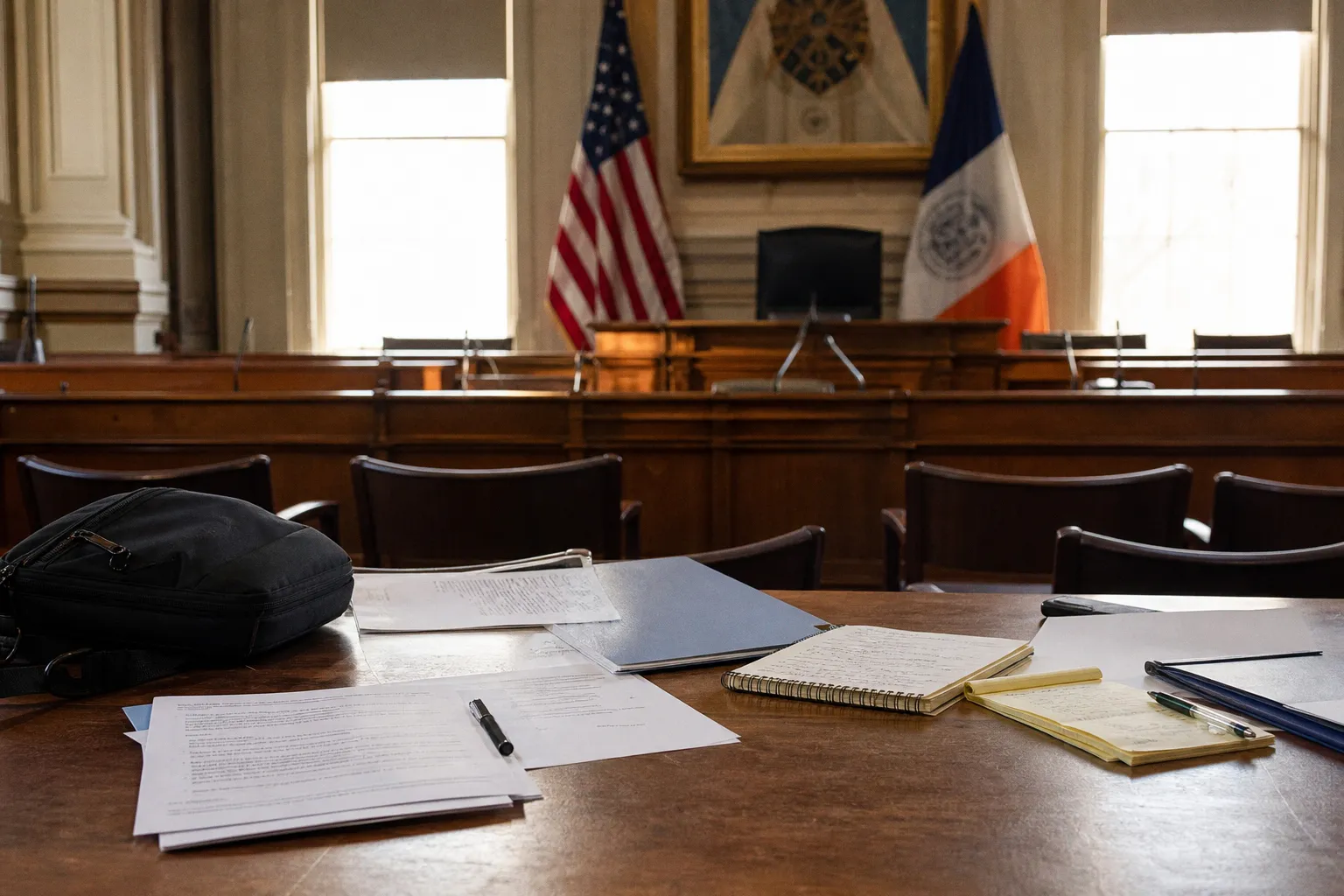
A hearing may be open to in-person witnesses, accessible by Zoom, and followed by a 72-hour written-testimony window, yet each of those routes carries its own operational details, public-record consequences, and, for organizations advocating on legislation, potential lobbying-accounting questions.
I have watched capable community organizations lose momentum not because their policy case was weak, but because the testimony lived in three different inboxes, the speaker had not been briefed on the committee’s actual scope, an accommodation request went in too late, or staff treated a public hearing as a one-off communications moment rather than part of a documented advocacy strategy. The work is manageable. It simply needs to be treated as part of the organization’s operating system, not as an emergency response to a calendar alert.
This checklist is the route I would use to move from “we should testify” to a credible, compliant, community-rooted appearance before the Council.
Start with the hearing itself, not the bill number
A bill can move through several stages, and a hearing can have a different purpose from the legislative outcome an organization hopes to influence. Some hearings concern a proposed local law; others concern oversight, implementation, agency performance, or a developing budget and service-delivery issue. That distinction shapes who should speak, what evidence belongs in the record, and how your activity may be classified internally for advocacy tracking.
Before assigning a witness, I would pull the current Council calendar entry and hearing notice, then confirm these basics:
- The committee and hearing purpose. Read the agenda rather than relying on the shorthand in an advocacy email. A hearing on agency oversight calls for a different testimony structure than a hearing on a bill’s text.
- Whether the matter is Land Use. The Subcommittee on Zoning and Franchises and the Subcommittee on Landmarks, Public Sitings, Resiliency, and Dispositions operate under separate Planning & Land Use instructions. Do not assume the general testimony workflow applies.
- The participation route. For non-Land Use committee hearings, the public may testify in person or register to testify remotely through Zoom Web or Zoom Phone. In-person witnesses do not need to preregister.
- The current logistics. Hearing dates, rooms, remote-registration links, committee assignments, and hearing-specific directions can change. The calendar entry closest to the hearing date is the operational source of truth.
- The practical question behind the hearing. Ask what the Council needs from a nonprofit witness that it cannot obtain from agency testimony, a fiscal note, or a general endorsement letter. Your organization’s lived service data, client-facing observations, and implementation knowledge are usually the answer.
The Council’s remote-attendance procedures have allowed public attendance at noticed physical locations and videoconference participation where public participation is permitted since June 13, 2022. That access has widened the advocacy ecosystem considerably, especially for smaller organizations that cannot spare a staff member for a long trip and uncertain waiting time at City Hall. But remote access does not remove the need for preparation; it shifts some of that preparation into technology, staffing, and document control.
A hearing is not merely a speaking opportunity. It is a public record, a relationship-building moment, and, in many cases, a piece of your organization’s advocacy trail.
Choose the witness and the message with operational reality in mind
The strongest nonprofit policy testimony rarely tries to carry every organizational priority at once. It does one job clearly: it helps Council members understand what a proposed action means for people, programs, workers, or neighborhoods, and it gives them a concrete decision to make.
I recommend deciding early whether your witness is appearing as:
1. An executive or policy leader, able to state the organization’s formal position and speak to systemwide implications.
2. A program leader, able to explain what implementation looks like on the ground, where eligibility rules break down, or why an administrative practice produces avoidable harm.
3. A coalition representative, able to demonstrate alignment among community stakeholders while being precise about whom they are authorized to speak for.
4. A directly affected community member, whose account can make the policy stakes unmistakable, provided the organization has obtained genuine consent, prepared the speaker appropriately, and avoided placing them in the position of disclosing sensitive facts just to make the case persuasive.
There is no universal oral-testimony time limit that applies across all Council hearings. A chair, agenda, or hearing-specific instruction may establish one. That uncertainty is not a reason to write vaguely; it is a reason to prepare a short spoken version that can stand on its own, alongside a fuller written submission.
A useful internal division looks like this:
| Component | Spoken testimony | Written testimony |
|---|---|---|
| Core purpose | Make one memorable, decision-relevant case | Create a durable record with context and support |
| Length | Built to be shortened if the chair directs it | As concise as possible, with room for detail |
| Best evidence | One or two program observations or carefully framed data points | Methodology, implementation examples, recommendations, attachments where appropriate |
| Tone | Direct, human, responsive to the room | Clear, documented, readable by staff after the hearing |
| Closing | A specific request to the committee or Council | The same request, stated in complete and trackable language |
The common error is treating the written statement as a transcript of what someone plans to say aloud. I would not do that. The spoken statement should have a clean spine: who you are, what you see, what the Council should do, and why delay has consequences. The written version can explain the service-delivery mechanics, identify affected populations without exposing private details, and answer foreseeable implementation questions.
For example, a nonprofit opposing an unfunded mandate does not need to say merely that a proposal will be “challenging.” It can explain whether compliance would require new data systems, staff training, altered intake workflows, multilingual materials, contract amendments, or a change in the way a program serves people with urgent needs. That is the difference between a position and useful legislative testimony.
Build the written record before the room opens
For general non-Land Use Council hearings, written testimony may be submitted up to 72 hours after the hearing adjourns. That window is valuable, particularly when committee questions reveal an issue your team needs to clarify, but I encourage organizations not to treat it as permission to start drafting after the hearing. A post-hearing submission should refine and strengthen your position, not rescue an unprepared one.
The Council accepts common written formats, including DOC, RTF, TXT, and PDF. The online testimony-registration form identifies DOC, DOCX, and PDF uploads and displays a maximum upload size of 10 MB. These are modest technical requirements, but they matter when an organization tries to append a large report, scanned letters, or a visually heavy slide deck at the last minute.
Before submitting, I would run through this practical sequence:
1. Name the hearing accurately. Include the committee, hearing date, and the bill, resolution, or subject when applicable. Staff should be able to place the document in the correct record without guessing.
2. State your organizational standing. Give a brief description of whom you serve, where you work, and what direct experience informs your position. Do not bury this in a long institutional history.
3. Lead with the recommendation. Support, oppose, amend, fund, delay, strengthen oversight, preserve a safeguard—say what you are asking the Council to do.
4. Separate evidence from aspiration. Program data, operational observations, and community feedback all have value, but they should be identified honestly. Do not present a limited client survey as citywide research.
5. Use examples without identifying people. A service pattern can be compelling without a client name, address, immigration history, health condition, or other personal information.
6. Keep the file accessible and lightweight. A searchable PDF or clean Word document is more useful than a beautifully designed file that is difficult to read on a phone or exceeds the upload limit.
7. Assign one person to retain the final version. Keep the submitted file, confirmation, hearing notice, speaker notes, and any follow-up correspondence together. This is invaluable for institutional memory and lobbying records.
The Council will not play prerecorded public testimony. If your written testimony includes a link to video or audio, it should also include a transcript of each linked recording. I see this as more than a procedural footnote: a transcript makes your evidence legible to staff, advocates, journalists, and community members who cannot or do not wish to access the recording.
If a multimedia asset is central to your case, ask whether it actually advances the policy request. Often, a short quotation from a transcript, contextualized in the written statement, is stronger than a link that may never be opened.
Make language access and accommodation requests part of the timeline
Accessibility cannot be a last-minute add-on to nonprofit legislative advocacy in NYC. The Council asks that requests for ASL, CART, or other accommodations, as well as non-English interpretation, be made at least three business days before the hearing. For interpretation requests, be ready to provide the hearing name and date, the requester’s full name, telephone number, email address, and, for Land Use matters, the requested language and interpretation mode.
Three business days is a minimum, not an ideal planning horizon. I would build an internal deadline earlier than the Council’s: as soon as the organization decides a particular staff member, board member, or community stakeholder may testify, ask what support would make their participation equitable and effective.
That includes practical questions that can disappear in a rush:
- Does the witness need interpretation for the hearing itself, for preparation calls, or both?
- Is the remote platform workable with the person’s assistive technology and internet connection?
- If the organization plans to bring a community member in person, who is covering transit, childcare, interpretation coordination, and the possibility of a long wait?
- Have you translated or orally reviewed the key policy request so the witness is not asked to endorse language they have not had a fair opportunity to understand?
- Does your communications team know not to post photos, clips, or personal details without clear permission?
This is where the nonprofit ecosystem can either reproduce exclusion or reduce it. A hearing process may technically allow public participation, but community participation is not meaningful if the people most affected by a decision have been asked to navigate an unfamiliar civic system without support.
The deadline for accommodation is not the beginning of access planning; it is the latest point at which a prepared organization should need to act.
Treat every submitted detail as public
Council testimony and comments become part of the public record. Personal information supplied to the Council is publicly available, and the Council advises witnesses not to include extra personal information beyond what is required or another person’s information without their express permission.
This deserves a direct conversation with every witness, especially when testimony involves housing insecurity, domestic violence, immigration concerns, disability, health, youth services, criminal legal-system involvement, or any other area where exposure can carry real risk. Good intentions do not make a disclosure reversible once it enters a public record.
I would establish a short review process before filing or speaking:
- Remove personal addresses, private phone numbers, personal email addresses, case numbers, and unnecessary identifying details.
- Use composites only with care, and label them accurately if an example combines more than one person’s experience.
- Confirm whether a staff member is speaking for the organization, in a professional capacity, or in an individual capacity.
- Avoid naming partner agencies, funders, landlords, employers, or clients in a way that creates avoidable conflict or confidentiality problems.
- Make sure the witness understands that remote testimony may still be public and that submitted documents can remain accessible after the hearing ends.
Privacy review is not an effort to drain testimony of humanity. It is how we protect the people whose experience gives the testimony its moral and practical force.
Know where testimony becomes lobbying activity
For a 501(c)(3), supporting or opposing legislation is not automatically forbidden. Federal tax rules allow some lobbying, but substantial lobbying can jeopardize tax-exempt status. The Internal Revenue Service distinguishes legislative lobbying from issue education, although the line depends on what the organization is saying, to whom, and for what purpose.
When an organization contacts members or employees of a local council to propose, support, or oppose legislation, or advocates for the adoption or rejection of legislation, it is attempting to influence legislation for federal tax purposes. A Council hearing statement supporting a bill may therefore be lobbying activity even when it is entirely mission-consistent and legally permissible.
At the city level, the definition of lobbying is also broad. It can include attempts to influence City Council determinations on local legislation or resolutions, as well as determinations concerning the calendaring or scope of a Council oversight hearing. An organization engaging in covered, non-exempt activity must register when its combined lobbying compensation and expenses exceed $5,000 in a calendar year.
That threshold is not a simplistic “did we hire a lobbyist?” test. Time spent by paid staff, consulting costs, preparation work, coalition activity, and the particular purpose of an interaction may all matter to a sound analysis. Tax exemption by itself does not resolve the City registration question, and a single Council appearance does not automatically mean registration is required.
I advise nonprofit leaders to create a modest but disciplined advocacy log, especially if Council engagement is becoming regular rather than occasional. Track:
| What to record | Why it matters |
|---|---|
| Bill, resolution, oversight subject, or hearing | Connects activity to the relevant governmental action |
| Staff and consultants involved | Supports compensation and expense tracking |
| Time spent preparing and participating | Helps the organization assess its advocacy footprint |
| Direct contacts with Council offices or staff | Clarifies the nature and purpose of communications |
| Written testimony and public materials | Preserves the organization’s stated position |
| Coalition roles and outside advocacy support | Helps identify activity that needs further review |
This is not a substitute for counsel or a lobbying-compliance professional where facts are close to a threshold or an exemption may apply. It is, however, the documentation habit that prevents legislative friction from becoming a preventable governance problem six months later.
Leave the hearing with an advocacy plan, not just a recording
The hearing itself is usually one point in a longer policy process. Council members and staff may ask questions that reveal implementation concerns, identify possible amendments, or signal where further evidence would be helpful. Agencies may make commitments that deserve follow-up. Coalition partners may need a common response rather than several competing ones.
Within a day or two, I would convene the internal team and answer four questions: What did the committee appear to need? What did we learn that changes our position or evidence? Who needs a follow-up message? And what must be logged for federal and City lobbying review?
If additional written testimony is warranted, use the 72-hour post-adjournment window carefully. Submit a focused clarification, not an emotional second speech. If the hearing exposed a gap in your data, name the gap and commit to supplying what your organization can responsibly document. If a Council member raised a concern that your program experience can answer, follow up with a concise note that respects staff time and keeps the policy request visible.
The strategic route through City Hall is not to be louder than every other voice. It is to be reliably useful: prepared for the correct hearing process, clear about the decision sought, protective of community members’ privacy, attentive to access, and honest about the advocacy obligations that come with trying to influence public policy.
For nonprofits, that kind of preparation does more than improve one day of testimony. It builds the institutional confidence to participate in New York City’s legislative process repeatedly, credibly, and with the community stakeholders most affected by the outcome still at the center of the work.