NYC Legal Aid Directories: A Case Manager Guide
The Legal Aid Society assists hundreds of thousands of individuals and families each year through civil legal services, criminal defense, and juvenile rights programs.
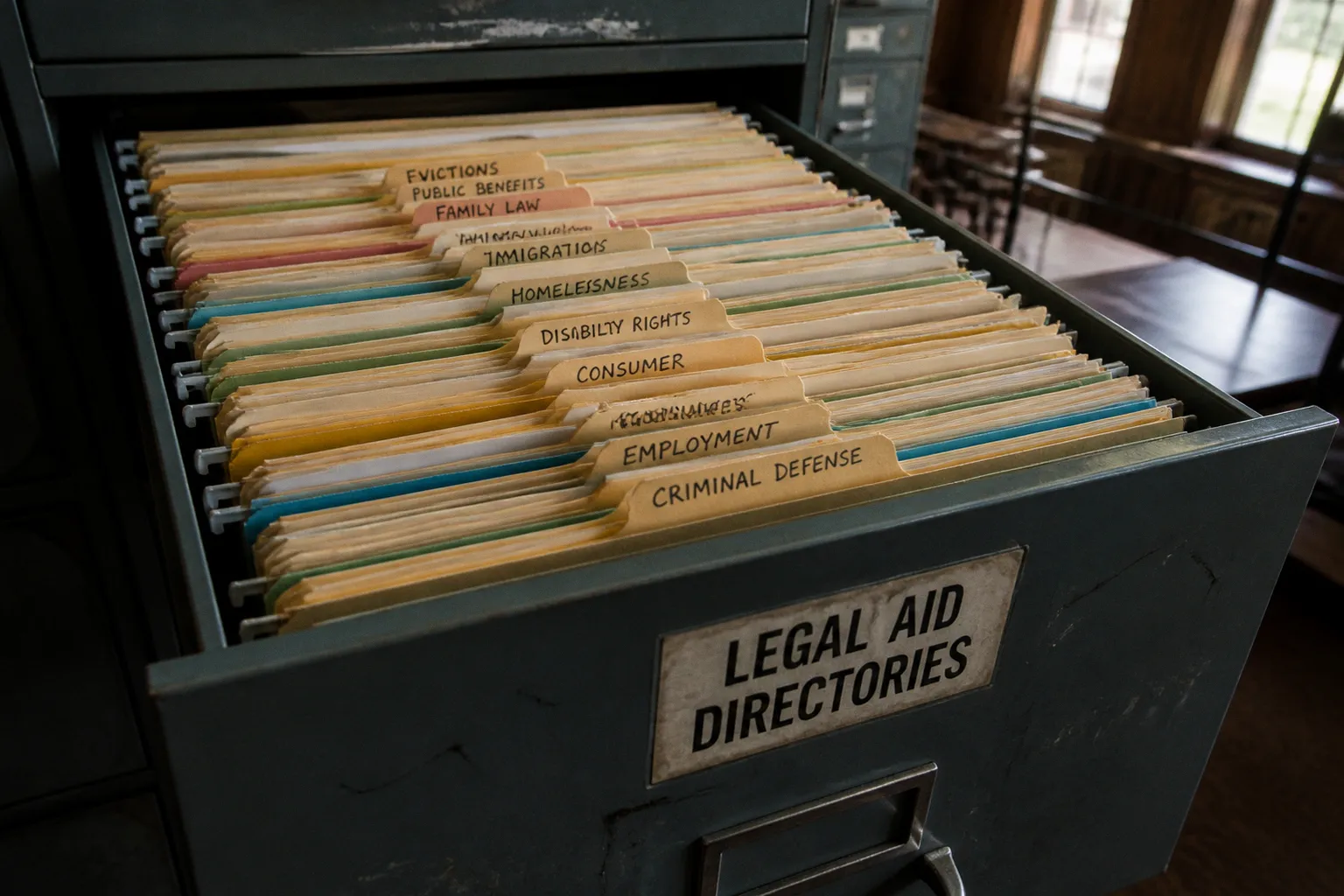
That scale explains the central problem for case managers: the issue is rarely the existence of legal aid. The issue is routing a client to the correct provider before a deadline closes the available options.
An NYC legal aid nonprofit directory search is therefore not a simple lookup. It is an intake operation. The case manager must classify the legal problem, identify the relevant borough and language capacity, separate information services from representation, and verify that the provider is accepting the case category at the time of referral.
The main lookup hubs are LawHelpNY, the NYC Human Resources Administration’s Office of Civil Justice, and the major citywide legal aid organizations. Each serves a different function. A directory provides coverage. A municipal program provides an eligibility and funding framework. A legal aid provider performs intake and determines whether it can act.
A directory is a routing layer. It is not a promise of representation.
The directory landscape in New York City
New York City’s civil legal services system is distributed across national, state, city, and provider-level platforms. No single database should be treated as a complete real-time registry of every active legal clinic, intake window, language service, or borough-specific program.
LawHelpNY as the broad search layer
LawHelpNY serves as a primary civil legal directory for New York State. It lists low-income legal service providers and searchable resources across multiple categories and languages. For a case manager, its value is breadth.
The platform is useful when:
- The client’s legal issue is not yet clearly classified.
- The appropriate borough provider is unknown.
- Language access is a material factor.
- The case may involve a specialized area such as housing, immigration, consumer debt, or public benefits.
- A local organization is needed rather than one of the largest citywide providers.
A LawHelpNY search should begin with the legal problem, not with the name of a familiar organization. Search terms such as eviction, benefits termination, wage violation, immigration status, consumer debt, or family safety produce a more useful initial map than a general search for free lawyers.
The directory result is a lead. It still requires verification. A listing may not reflect temporary intake limits, geographic restrictions, conflict rules, or the provider’s current capacity.
The Office of Civil Justice as the city-funded framework
The NYC Human Resources Administration’s Office of Civil Justice oversees city-funded free legal services for eligible New Yorkers facing eviction, immigration challenges, and employment or wage violations.
OCJ is relevant when the case falls within a city-funded civil legal service area. It also helps case managers understand the distinction between a public legal service entitlement or program pathway and a private attorney referral. Official city-sponsored legal assistance is free for eligible clients. It should not be represented as a fee-for-service arrangement requiring a deposit.
The practical limitation is scope. OCJ is not a universal directory for every civil legal problem in New York City. It should be used alongside provider intake systems and broader search tools.
Provider-level intake systems
The largest organizations operate their own intake structures and specialized projects. The main citywide names include:
- The Legal Aid Society.
- Legal Services NYC.
- New York Legal Assistance Group, commonly known as NYLAG.
- Brooklyn Defender Services.
- The Bronx Defenders.
These organizations do not have identical service models. Some concentrate on civil legal matters. Others combine civil representation with criminal defense, family defense, immigration, or community-based advocacy. A case manager should not infer eligibility or capacity from organizational size alone.
Legal Services NYC operates a centralized intake hotline at 917-661-4500, Monday through Friday, from 9:30 a.m. to 4:00 p.m. Multi-language interpretation is available to facilitate referrals.
The Legal Aid Society operates specialized access points. Its Access to Benefits Helpline is 888-663-6880, Monday through Friday, from 10:00 a.m. to 3:00 p.m. Its HIV/AIDS Representation Project Helpline is 718-579-8989.
These numbers are operational entry points. They are not substitutes for case classification. A referral that reaches a general intake channel without a clear issue statement can produce delay, duplicate screening, or an immediate transfer.
Classify the legal problem before searching
The quality of a directory result depends on the quality of the issue classification. A client may describe a crisis in general terms, but the legal service system routes cases through narrower categories.
A housing case may involve:
- An eviction notice.
- A pending Housing Court matter.
- A lockout or illegal eviction.
- Rent arrears.
- A subsidy or public benefits problem affecting rent payment.
- Housing conditions.
- Discrimination.
- A lease or renewal dispute.
These are not interchangeable intake categories. The same client may need more than one referral, but the first referral should identify the immediate legal threat.
An immigration matter may involve:
- Removal proceedings.
- Detention.
- A family-based petition.
- Asylum.
- A work authorization issue.
- An application for humanitarian relief.
- A document or status problem affecting access to housing or benefits.
A benefits matter may concern cash assistance, SNAP, Medicaid, disability benefits, or an administrative termination. The appropriate provider may depend on the program, the notice received, the hearing date, and whether the client is already represented.
The case manager should record the client’s description without converting uncertainty into a legal conclusion. The intake summary should distinguish verified facts from client-reported facts.
A functional summary contains:
1. The legal category. Housing, immigration, public benefits, employment, consumer debt, or another defined area.
2. The current procedural stage. No notice, notice received, court case filed, hearing scheduled, order entered, or enforcement pending.
3. The relevant date. Court date, response deadline, termination date, filing deadline, or other date printed on the document.
4. The client’s location. Borough and, where relevant, the location of the court or agency.
5. Language needs. Preferred spoken language and whether interpretation or translated documents are needed.
6. Existing representation. Current attorney, prior intake, open case, or conflict concern.
7. Documents available. Notices, orders, leases, agency correspondence, pay records, identification, and prior legal filings.
The point is not to create a legal brief. It is to create a routing record that allows an intake worker to decide whether the matter fits the provider’s program.
Match the search to the client’s constraints
A New York free legal services database can return a provider that is legally relevant but operationally unusable. Coverage is multidimensional. Subject matter is only one field.
Geography
A provider may serve all five boroughs, one borough, selected neighborhoods, or clients connected to a particular court or agency. Geography can determine whether the organization can open the case.
For directory purposes, the case manager should record:
- Client residence.
- Location of the dispute.
- Court location, if a case is pending.
- Employer or workplace location for wage matters.
- Detention or shelter location where applicable.
- Any neighborhood, program, or community-organization connection that affects eligibility.
A citywide label does not mean every intake unit accepts every case from every borough.
Language access
Language is an intake variable, not an administrative footnote. LawHelpNY provides searchable resources across multiple languages. Legal Services NYC also uses multi-language interpretation in its centralized intake process.
The referral record should state the preferred language and the language required for written notices. A client who can conduct a brief conversation in English may still require interpretation for a court filing, benefits hearing, or immigration screening.
Income and eligibility
Legal aid eligibility differs by provider and program. Exact income cutoffs are not uniform across the NYC legal services ecosystem. A case manager should avoid assigning a single assumed threshold to every organization.
The intake record should instead capture the facts providers commonly need to assess:
- Household size.
- Current income sources.
- Employment status.
- Public benefits.
- Housing status.
- Disability or medical factors where relevant.
- Immigration or citizenship information only when necessary for the legal issue.
- Whether the client is detained, facing eviction, or subject to another urgent condition.
The directory can identify the provider. The provider determines eligibility.
Urgency
An ordinary intake referral and an emergency legal referral are different workflows. The search should prioritize the procedural deadline.
The following conditions require explicit escalation in the referral:
- A court appearance within days.
- A lockout or immediate housing loss.
- Detention or imminent removal.
- A benefits termination that affects food, shelter, or medical care.
- An unpaid wage claim approaching a filing deadline.
- A court order already entered.
- A client who has received multiple notices but cannot identify which one controls.
The case manager should not rely on a directory’s general description to establish the legal deadline. The date on the actual notice or court document controls the triage record.
Use a layered search instead of a single listing
A reliable NYC pro bono legal aid locator workflow has several passes. The objective is not to collect the largest number of names. It is to reduce referral failure.
Pass one: identify the legal category
Start with the problem that creates the most immediate legal exposure. If a tenant has both a benefits interruption and a Housing Court date, the court date may determine the first legal referral. The benefits issue can be routed in parallel.
Pass two: search the broad directory
Use LawHelpNY to identify providers by issue, language, and geography. Record the provider name, service category, and any stated intake route. Do not treat the search result as confirmation that the provider is currently accepting the matter.
Pass three: check municipal program coverage
Review whether the matter falls within an Office of Civil Justice service area, including eviction, immigration, or employment and wage violations. This establishes whether a city-funded pathway may be relevant.
Pass four: check direct provider intake
Use the provider’s own intake channel when the organization has a specialized helpline or centralized screening system. This is particularly important for the Legal Aid Society and Legal Services NYC.
Pass five: verify the referral
A referral is not complete when a phone number is written into a case note. It is complete when the client has a defined next action and the case manager has recorded the result.
The verification record should show:
- Date and time of contact.
- Channel used.
- Provider or intake unit contacted.
- Whether a screening occurred.
- Documents requested.
- Follow-up date.
- Reason for rejection or transfer, if provided.
- Any deadline communicated by the intake worker.
- Whether a second referral is required.
This is a compliance metric for the case management process. It also prevents repeated referrals to the same closed or unsuitable intake channel.
| Routing layer | Primary function | Typical use | Main limitation |
|---|---|---|---|
| LawHelpNY | Broad provider and resource search | Find civil legal services by issue, language, and location | Listing may not reflect current capacity |
| NYC HRA Office of Civil Justice | City-funded legal service framework | Housing, immigration, employment, and wage-related pathways | Does not cover every legal issue or provider |
| Legal Services NYC intake | Centralized provider screening | Referral into Legal Services NYC programs | Intake hours and program scope apply |
| Legal Aid Society helplines | Specialized access points | Benefits and HIV/AIDS-related legal representation, among other services | A specialized line is not a universal intake |
| Individual nonprofit intake | Case acceptance decision | Confirm eligibility, conflicts, documents, and representation | Rules vary by organization and program |
Build the referral packet around documents
The most efficient referral packet is short, chronological, and document-led. A provider needs the facts that establish the legal posture. A large unstructured file increases review time.
For a housing matter, the packet may include the lease, notices, court papers, rent records, subsidy documents, and relevant correspondence. For a benefits matter, it may include the agency notice, application or recertification record, benefit history, and hearing information. For an employment matter, pay records, schedules, written policies, termination notices, and communications may be relevant.
The packet should use a stable naming convention. For example:
01_court_notice_date02_lease03_agency_letter_date04_client_timeline
The specific naming system is less important than consistency. Intake staff should be able to identify the controlling document without opening every file.
The case manager should also prepare a brief chronology:
- Date of the first event.
- Date the client learned of the problem.
- Date of any notice.
- Date of any agency or court response.
- Current status.
- Next known deadline.
The chronology should not contain legal conclusions unless they come from an existing attorney or official document. A statement such as the landlord violated the law should be replaced with the underlying event: the client reports that the landlord changed the locks on a specified date.
The strongest referral packet is not the longest one. It is the one that exposes the controlling date and document first.
Distinguish information from representation
Directory users routinely confuse four different service levels:
1. Self-help information. Forms, instructions, legal education, and explanations of process.
2. Brief advice. Limited guidance about a defined issue, often without an ongoing attorney-client relationship.
3. Pro bono assistance. A volunteer attorney or organization provides help within a limited scope.
4. Full representation. The provider accepts the matter and acts for the client through an agreed legal scope.
Court Help Centers may provide information, forms, and limited pro bono advice where volunteer programs exist. They do not automatically provide full legal representation or formal legal advice for every case.
This distinction must appear in client-facing communication. Telling a client that a directory has found a lawyer can create a false expectation. The accurate statement is that a provider has been identified and the client must complete intake or screening.
The same discipline applies to city programs. Free legal services for eligible clients do not guarantee acceptance of every case. Subject matter, eligibility, conflicts, capacity, procedural posture, and urgency still govern the decision.
Common failure points in directory use
Treating a general listing as live capacity data
Directories are designed for discovery. They are not always live queue-management systems. A provider may have changed its intake hours, narrowed its service area, or paused a category.
The corrective action is simple: record the date of verification and the result of direct contact.
Sending a client without the deadline
A referral that says eviction assistance but omits the court date is incomplete. The intake worker must know whether the case is pre-litigation, pending, or subject to an existing order.
The date should appear in the first line of the case summary.
Searching by organization instead of issue
A known brand is not a classification system. The Legal Aid Society, Legal Services NYC, NYLAG, Brooklyn Defender Services, and The Bronx Defenders have different programs and intake routes. The correct organization depends on the legal problem and the client’s facts.
Assuming borough coverage
New York City is one service market but not one intake jurisdiction. Borough, court, neighborhood, employer location, and community affiliation can affect routing.
A case manager should document why a provider was selected, not only which provider was selected.
Treating language access as automatic
A provider may have multilingual capacity without offering every language through every intake channel. Interpretation can be available for phone screening but not for a particular appointment time or document process.
The referral should identify language needs before the first contact.
Repeating failed referrals
A client can lose time when each unsuccessful contact is treated as a new search. The case record should preserve the reason for each failed referral: no coverage, no capacity, conflict, missing document, ineligible matter, or unreachable client.
This creates an escalation path rather than a loop.
A practical directory record for case managers
A case manager can maintain one structured record for each legal referral. The record need not be a separate software system. It can be a controlled field set in an existing case management platform.
Recommended fields include:
- Client identifier.
- Legal issue category.
- Subcategory.
- Borough and relevant location.
- Language.
- Household size and income information required for screening.
- Court or agency involved.
- Procedural stage.
- Next deadline.
- Provider searched.
- Directory or intake channel used.
- Date of last verification.
- Documents sent.
- Screening result.
- Follow-up date.
- Escalation status.
- Client notification status.
The data model should separate provider status from client status. A provider can be active in the directory while the client’s case remains unaccepted. These are different fields.
It should also separate a referral from a representation outcome. A referral means the client was directed to an intake pathway. Representation means the organization agreed to act. The difference matters for reporting, compliance metrics, and client safety.
For organizations managing many referrals, useful database queries include:
- Cases with a court date inside the next seven days and no confirmed intake.
- Referrals older than five business days without a provider response.
- Clients requiring interpretation whose intake has not been completed.
- Housing cases with a notice uploaded but no deadline field.
- Cases rejected for capacity that have not received a second referral.
- Duplicate referrals to the same provider within a defined period.
- Open legal needs with no documented client notification.
These queries convert a directory from a static list into an operational control.
How to route the main legal issue areas
Housing and tenant matters
Housing referrals should be separated by stage. A client facing an eviction notice needs a different response from a client with a scheduled court appearance or an executed eviction.
The record should capture the type of notice, the court information, the rent or subsidy context, and any immediate loss of access to the home. Tenant legal aid resources in NYC are often organized around eviction prevention, housing court, conditions, subsidy problems, and related public benefits issues.
If a housing problem is linked to a benefits interruption, the case manager should consider parallel referrals. One provider may address the housing proceeding while another handles the administrative benefits issue.
Immigration matters
Immigration intake requires careful handling of procedural status. The record should identify whether the client is detained, in removal proceedings, seeking a form of relief, dealing with work authorization, or facing a family-related immigration issue.
Do not summarize an immigration matter only as undocumented or immigration problem. Those labels do not identify the legal pathway. The relevant document, proceeding, or deadline is more useful.
Public benefits
The Legal Aid Society’s Access to Benefits Helpline provides a defined intake route at 888-663-6880, Monday through Friday, from 10:00 a.m. to 3:00 p.m.
Benefits referrals should include the agency, program, notice date, effective date of the proposed action, and hearing information. If the client has no food, shelter, or medical coverage because of the decision, the urgency should be stated as a service-impact fact.
Employment and wage violations
The Office of Civil Justice includes city-funded legal services for eligible New Yorkers facing employment and wage violations. The case record should distinguish unpaid wages, wage theft, retaliation, discrimination, termination, and workplace safety issues where known.
Pay records and written communications can establish the basic timeline. The case manager should avoid estimating damages unless the figure is supported by records.
HIV/AIDS-related legal needs
The Legal Aid Society’s HIV/AIDS Representation Project operates a specialized helpline at 718-579-8989. A referral should preserve confidentiality and disclose only the information needed for intake. The existence of a specialized project does not eliminate the need to identify the underlying legal issue, such as housing, benefits, employment, or discrimination.
Governance and nonprofit legal assistance
The directory is not limited to services for individual clients. NYC’s nonprofit sector also needs legal support for organizational operations.
The NYC Department of Small Business Services partners with Lawyers Alliance for New York to provide free pro bono legal and governance assistance to qualifying community-based nonprofit organizations in low- and moderate-income NYC neighborhoods.
This pathway belongs in a separate organizational-services branch of a directory. It should not be mixed with individual civil legal aid. The intake fields are different:
- Nonprofit status.
- Governance question.
- Contract or compliance issue.
- Employment or operational matter.
- Neighborhood or community served.
- Eligibility for the program.
- Documents such as bylaws, board records, contracts, or filings.
Separating individual and organizational pathways prevents an avoidable classification error. A nonprofit seeking governance assistance is not a tenant legal aid referral, even if both cases appear in the same broader directory.
The operating standard for a reliable referral
A case manager does not need a perfect database. The requirement is a controlled process that makes uncertainty visible.
The standard should be:
- Use a broad directory for discovery.
- Use municipal portals for program context.
- Use provider intake channels for acceptance decisions.
- Record deadlines from source documents.
- Track language and geography as routing fields.
- Separate information, brief advice, pro bono help, and full representation.
- Mark the verification date.
- Escalate urgent cases when the first provider cannot accept them.
- Never record a referral as representation without provider confirmation.
The city’s legal aid ecosystem is large enough that directory quality depends less on the number of entries than on the accuracy of the connections between issue, client, deadline, and intake channel.
Actionable database queries
- Find every case with a housing court date and no confirmed legal intake.
- Filter referrals by borough, language, and legal category before assigning a provider.
- Flag any listing not directly verified within the organization’s review interval.
- Separate city-funded service pathways from general nonprofit referrals.
- Track rejected referrals by reason so capacity problems do not remain invisible.
- Create a second-referral queue for urgent cases without provider acceptance.
- Report representation outcomes separately from referral volume.
The correct use of an NYC civil legal services directory is therefore procedural. Search, classify, verify, document, and escalate. That sequence gives case managers a usable route through a fragmented service market without overstating what any directory or legal aid provider can deliver.