NYS sales tax exemption: the road to ST-119 approval
Federal tax-exempt status does not extend to New York State sales tax. An organization holding an IRS 501(c)(3) determination letter must still secure a separate New York State sales tax exemption…
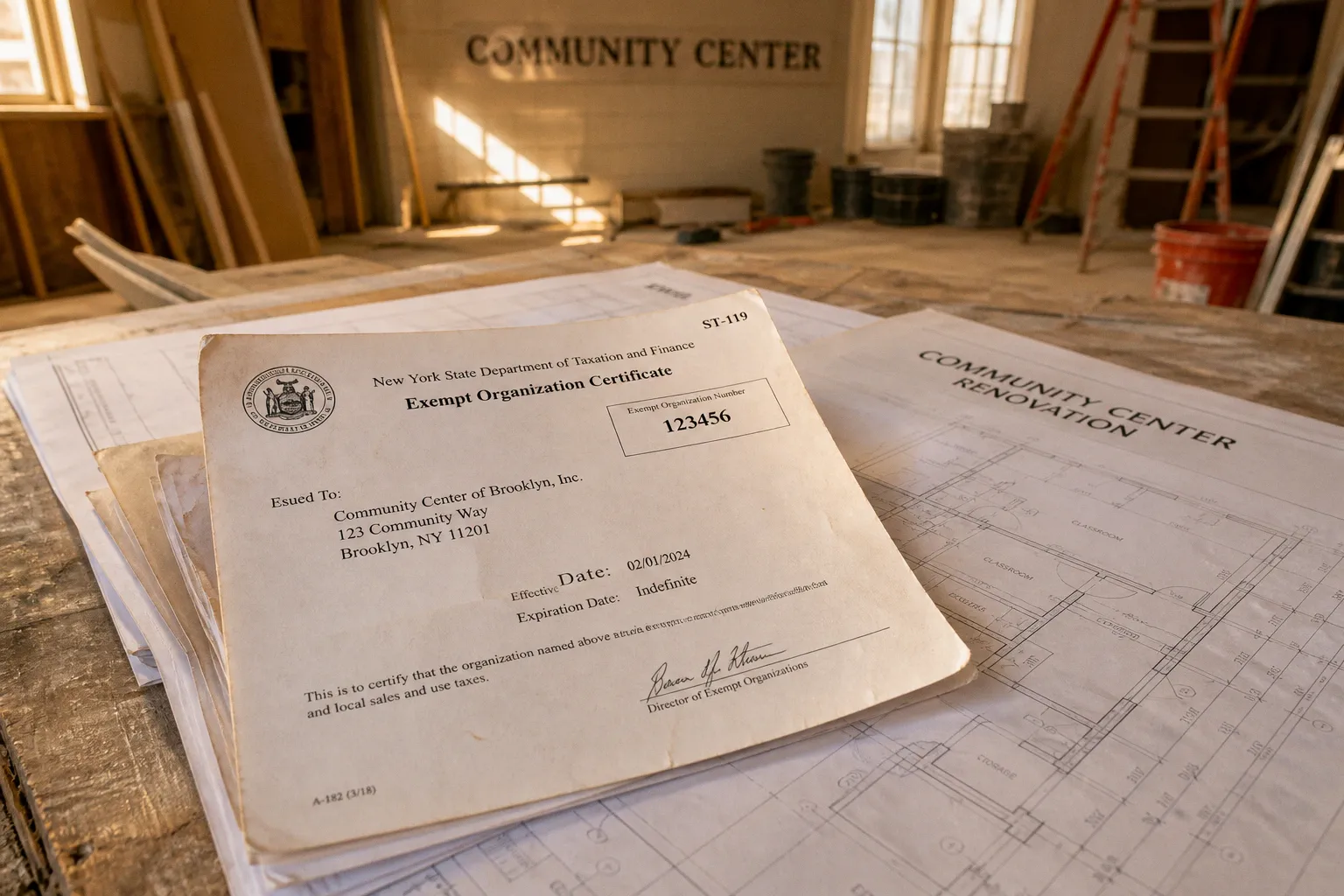
Federal tax-exempt status does not extend to New York State sales tax. An organization holding an IRS 501(c)(3) determination letter must still secure a separate New York State sales tax exemption through Form ST-119.2 before any vendor can lawfully apply the exemption at the point of sale. This bifurcation is the most common compliance error in the NYC nonprofit sector: organizations operate under the assumption that an IRS letter carries automatic state-level effect. It does not. The state-level exemption lives in a parallel administrative track, administered by the NYS Department of Taxation and Finance, and results in a distinct six-digit identifier that bears no structural resemblance to the federal EIN.
The two-track exemption architecture
The IRS 501(c)(3) determination letter establishes federal income tax exemption. The New York State sales tax exemption is a different instrument, issued under Tax Law § 1116, and it applies only to the state's 4% combined sales and use tax (plus any local add-ons). The two identifiers do not interchange:
- Federal EIN: 9 digits, format XX-XXXXXXX, issued by the IRS.
- NYS exemption number: 6 digits, prefix "EX", issued on Form ST-119 by the NYS Tax Department.
A federal Employer Identification Number is not a sales tax exemption certificate. Presenting an EIN to a vendor in lieu of an ST-119 number is a documentation failure, not a clerical oversight.
The processing timeline for ST-119.2 typically runs one to two months from receipt of a complete submission, though the department does not publish a guaranteed turnaround. Expedited or real-time online tracking options are not formally disclosed in current departmental guidance.
Filing Form ST-119.2: required inputs
The application package submitted to the NYS Tax Department must contain three core components:
1. Form ST-119.2 — Application for an Exempt Organization Certificate, completed and signed by an authorized officer.
2. IRS 501(c)(3) determination letter — current copy, including any subsequent updates or adverse rulings.
3. Organizing documents — certificate of incorporation, bylaws, or equivalent, demonstrating the entity's nonprofit purpose and operational scope.
Supporting items requested on a case-by-case basis include financial statements, evidence of in-state activity, and confirmation of charitable registration with the NYS Office of the Attorney General's Charities Bureau. Incomplete filings delay issuance; the department does not process partial submissions.
Output: what ST-119 approval produces
A successful ST-119.2 application generates two distinct forms:
| Document | Function | User |
|---|---|---|
| Form ST-119 | Exempt Organization Certificate carrying the six-digit EX-prefix exemption number | Retained by the organization; reference document |
| Form ST-119.1 | Exempt Purchase Certificate — completed per transaction and presented to vendors | Presented to sellers at the point of exempt purchase |
Form ST-119 establishes the organization's standing. Form ST-119.1 is the transactional instrument: a fresh, completed ST-119.1 must accompany each exempt purchase, with the EX-number entered in the certification block, the vendor's name and address listed, and a description of the property or service being acquired. Blank certificates held on file and reused without per-transaction completion do not satisfy the documentation standard.
Scope and exclusions of the exempt purchase certificate
Form ST-119.1 covers purchases of tangible personal property and services consumed in the organization's exempt operations. Several categories fall outside its coverage:
- Motor fuel and diesel motor fuel — exempt purchases of these require Form FT-500, FT-1020, or FT-1021-A, not ST-119.1.
- Personal purchases by employees, officers, or board members — ST-119.1 covers organizational acquisitions only. Use of the certificate for individual benefit is misuse.
- Purchases by related for-profit entities — affiliates, subsidiaries, or commercial partners of the exempt organization cannot ride on the certificate.
When an exempt organization engages in selling taxable goods or services — through a thrift shop, café, admissions-based programming, or recurring remote sales into New York — it must register for a Certificate of Authority and collect and remit sales tax on those transactions. The exemption applies to inputs, not to the organization's own revenue-generating activities.
Vendor compliance: the seller's burden
The exemption shifts documentation responsibility to the seller at the point of sale. Vendors accepting Form ST-119.1 must comply with retention and collection rules enforced by the Tax Department:
- Retention period: minimum three years from the date of the last exempt sale covered by the certificate.
- Collection window: 90 days from the date of delivery — a completed ST-119.1 must be obtained from the buyer within this window, otherwise the burden of proof shifts to the seller to demonstrate the sale was exempt.
- Misuse penalty: 100% tax penalty on the seller for accepting a certificate that is fraudulent, altered, or applied to a non-qualifying transaction.
Vendors are not required to verify the EX-number against a public registry before accepting the certificate, but they are required to retain the document and produce it on audit. Failure to maintain the file for three years converts a valid exempt sale into a seller liability.
Edge cases and operational fault lines
Three recurring scenarios produce compliance defects across NYC's nonprofit landscape:
Scenario 1 — new organizations in formation. Pre-operational entities that have not yet received an IRS determination letter cannot file ST-119.2. The state application requires the federal letter; without it, the application sits in administrative limbo. The workaround is to file the IRS Form 1023 or 1023-EZ first and accept the sequential processing delay.
Scenario 2 — multi-state operations. An organization shipping goods into New York from out-of-state facilities must still hold a New York ST-119 exemption certificate. The state's sales tax is destination-based for most tangible personal property; vendor location is irrelevant.
Scenario 3 — mergers and asset transfers. When two exempt organizations combine, the surviving entity must either inherit the EX-number through a formal succession filing or apply for a new ST-119.2. The EIN changes; the EX-number must follow the same administrative track.
Processing, tracking, and re-application
The Tax Department does not publish a public-facing status tracker for ST-119.2 applications. Communications arrive by mail. Typical administrative markers:
| Stage | Indicator |
|---|---|
| Initial receipt | No formal acknowledgment in most cases |
| Incomplete filing | Notice requesting additional documentation |
| Approval | Form ST-119 and ST-119.1 packet issued |
| Denial | Notice citing deficiency; resubmission permitted |
Re-application after denial requires addressing the cited deficiency in the original filing. The process restarts; prior submission fees, where applicable, are not refunded.
Penalties for misuse
Misuse of the ST-119.1 certificate by a buyer — using it for personal purchases, applying it to motor fuel, or presenting it after organizational status has been revoked — triggers a 100% tax penalty on the value of the transaction, plus interest. The penalty applies to the buyer; the seller who knowingly accepts a misused certificate faces parallel liability. The penalty structure is symmetric by design: both counterparties carry compliance exposure.
Actionable database queries
For sector cartographers tracking exemption coverage across the NYC nonprofit population, the following queries surface operational gaps:
- Cross-reference NYS charities registry entries against the published EX-number directory to identify registered charities operating without state sales tax exemption.
- Flag organizations with active IRS 501(c)(3) status older than 90 days and no corresponding ST-119 issuance date.
- Identify vendors accepting exempt purchase certificates from organizations whose EX-numbers are not present in the current state directory — a signal of either expired status or unrecorded approvals.
- Match organizations with reported retail or food-service revenue against Certificate of Authority registration to surface unregistered sales activity.
Operational takeaway
The state-level exemption is a parallel administrative track, not a federal derivative. The six-digit EX-number is the binding identifier; the IRS letter is the prerequisite, not the substitute. Filing ST-119.2 with complete supporting documentation moves the application through standard channels in roughly one to two months. ST-119.1 is transactional, per-purchase, and per-vendor. Misuse penalties are symmetric at 100%. Vendors carry a three-year retention obligation and a 90-day collection window. Motor fuel, diesel, personal purchases, and affiliate acquisitions are excluded from coverage. Registration as a seller is required when exempt organizations generate taxable revenue.