Understanding the Role of Labor Unions in the NYC Nonprofit Landscape
labor unions disbursed in recent filings captured by Candid — a fiscal flow most NYC nonprofit operators treat as off-network.
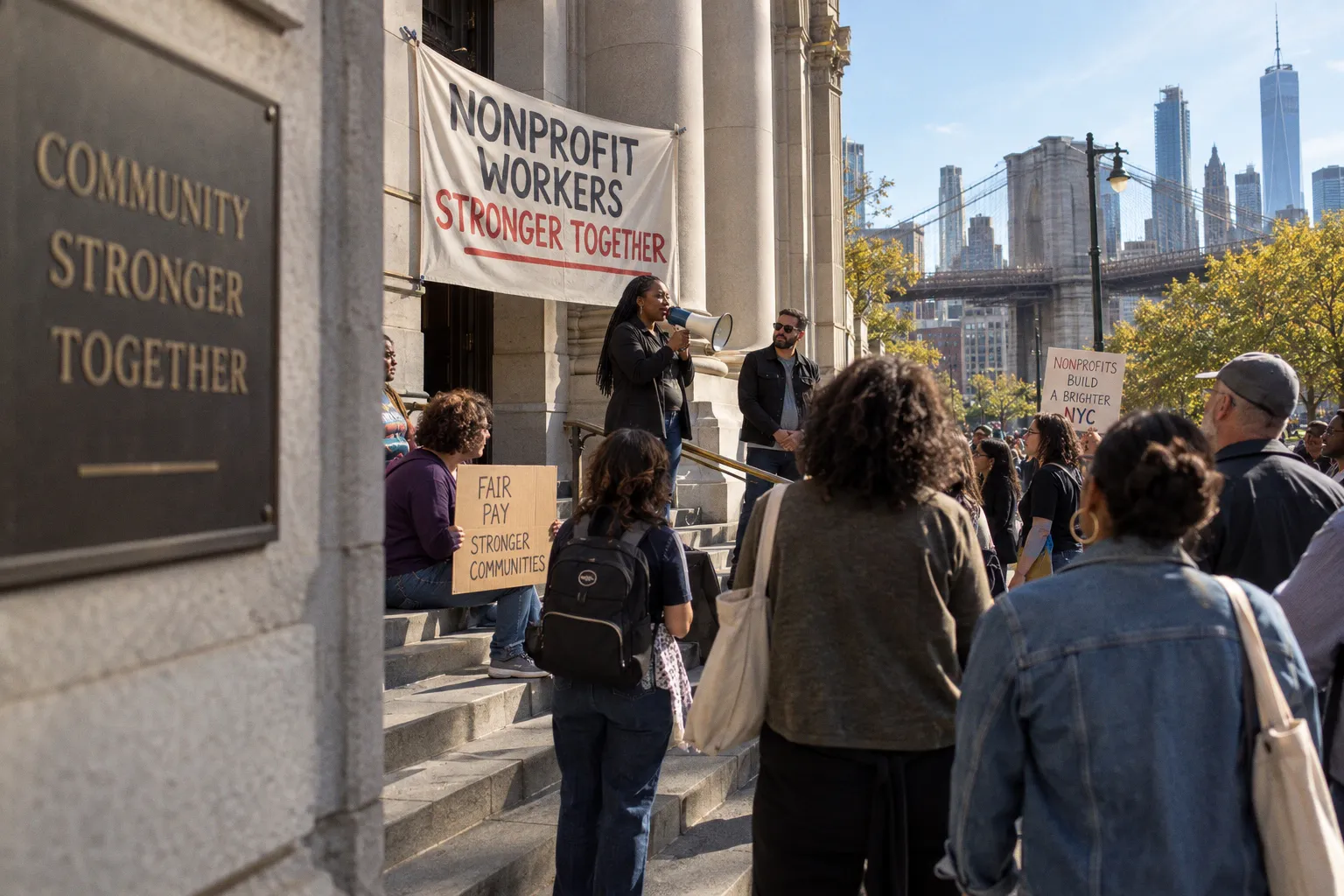
$252 million. That is the volume of grants U.S. labor unions disbursed in recent filings captured by Candid — a fiscal flow most NYC nonprofit operators treat as off-network. Per Candid's research-based analysis, unions are 501(c)(5) entities, and the compliance mechanics, fiscal posture, and grantmaking footprint that designation produces belong on the sector map.
The 501(c)(5) compliance layer
Under section 501(c)(5) of the tax code, unions share nonprofit status with agricultural and horticultural organizations. They do not share it with charitable 501(c)(3)s. Three operational divergences follow:
- Tax deductibility. Contributions to 501(c)(5)s are not deductible to the donor. Cross-sector funding pipelines require distinct accounting treatment.
- Filing baseline. Unions file Form 990, 990-N, or 990-EZ annually — same public-visibility threshold as 501(c)(3)s, same presence in Candid's data tools.
- Recognition origin. Federal right-to-form status dates to the 1935 National Labor Relations Act. Recognition runs through NLRB certification or voluntary employer acknowledgment.
NYC-based operators running union-nonprofit partnerships should pull Form 990 on any active labor counterpart and confirm 501(c)(5) status before routing restricted dollars.
Mapping the structural hierarchy
Candid's analysis places unions as nested entities. National or international bodies set strategy and aggregate dues. Locals negotiate contracts and run on-the-ground organizing. Dues flow upward; programs and resources flow downward. The $252 million grantmaking figure cited by Candid represents outgoing flows only. The incoming dues base that finances national infrastructure is materially larger and is not embedded in that number. Compliance officers tracking labor-side funding should isolate the two streams in any overhead ratio calculation.
Composition variables
Candid reports three demographic data points worth integrating into a workforce model:
1. Black workers carry a higher union membership proportion than other racial groups per Bureau of Labor Statistics data.
2. Hospital nurses post a unionization rate roughly three times the private-sector average.
3. Private-sector union density has declined overall, yet ticked up in certain women-dominated professions.
NYC's hospital and ambulatory care clusters — NAICS 622 and 621 — operate directly against this backdrop. Fiscal health of those providers correlates with the union density figures above.
What to run now
- Query Candid for 501(c)(5) filers active in the five boroughs; cross-reference against active 501(c)(3) grantee lists to map cross-sector flow.
- Pull Form 990 Schedule J for any union partner exceeding $1M in local revenue; assess executive compensation alignment.
- Filter BLS union-density tables by NAICS 622 and 621 at the NYC MSA level.
- Confirm NLRB recognition status for any unionized NYC nonprofit workforce before assuming collective bargaining coverage.
- Separate grantmaking outflows from dues inflows in any partner's 990 to prevent double-counting in fiscal health scoring.