Mapping the Intellectual Landscape of Philanthropic and Nonprofit Research
According to an arXiv study released this week, researchers have mapped 60,917 Web of Science articles to chart the intellectual structure of philanthropic and nonprofit studies.
The bibliometric exercise isolates three dominant clusters—nonprofit organizations, social movements, and voluntary action—and documents the field's migration into biomedicine and technology. For NYC practitioners, the cartography functions as a routing tool: it identifies which academic subdomains now produce the evidence base informing local policy, grant strategy, and program design.
The Bibliometric Topography
The dataset covers 60,917 indexed articles drawn from Web of Science. Three clusters account for the field's core: nonprofit organizations, social movements, and voluntary action. Adjacent disciplines—biomedicine and technology—register as extension points rather than peripheral citations. The structural implication for nonprofit leaders: the evidence base is interdisciplinary. Strategy papers, workforce research, and program evaluation increasingly draw from outside the traditional nonprofit literature, expanding the relevant search surface for any analyst building a sector dashboard or compiling a literature review for a board memo.
Pressure Points in the 2026 Operating Environment
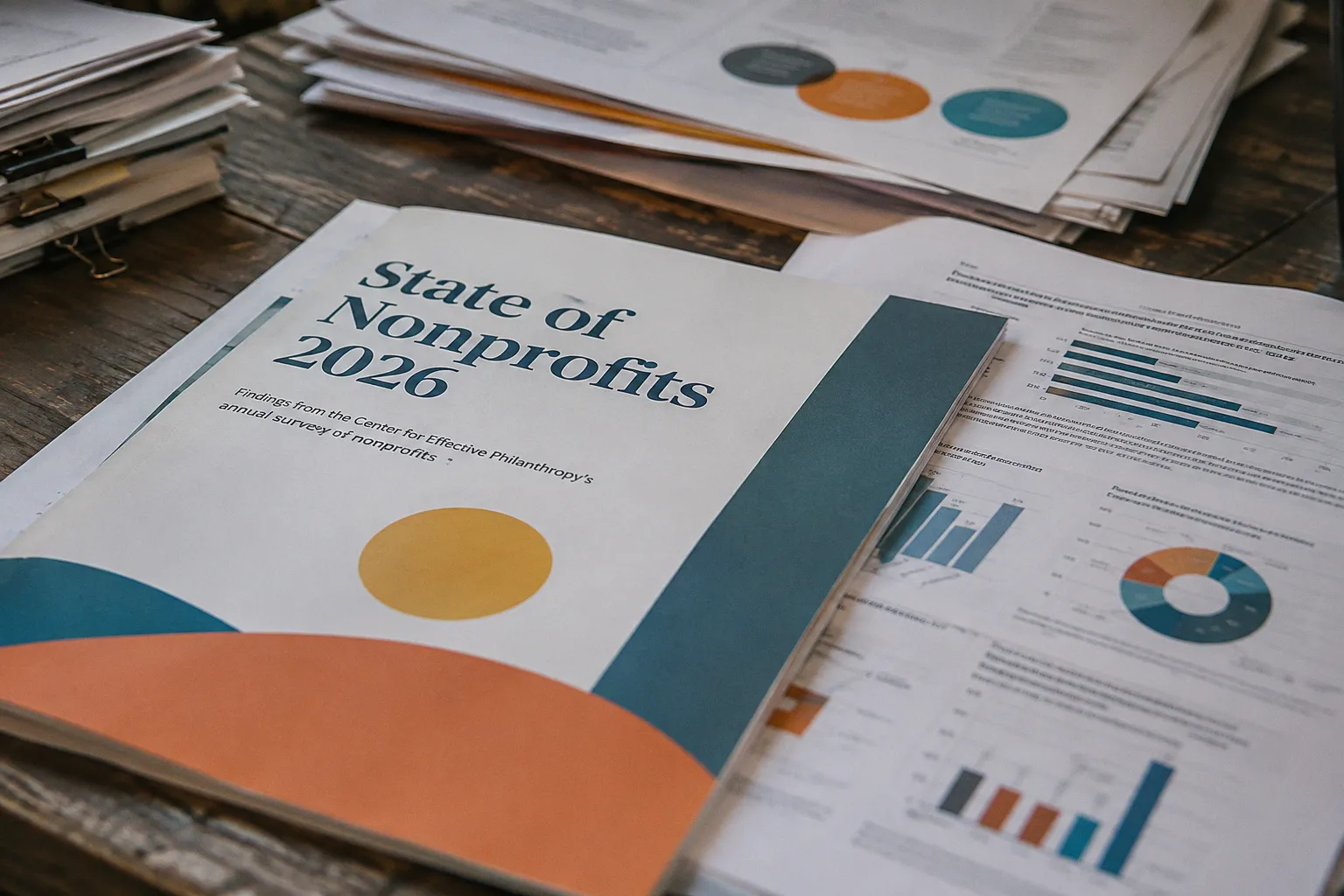
Three data sources converge on a single operating picture. The Center for Effective Philanthropy's State of Nonprofits 2026 surveyed 380 U.S. nonprofits and surfaced three operational stress signals: rising CEO burnout, greater difficulty securing foundation and state funding, and widespread adoption of new fundraising strategies and reserves. The Nonprofit Finance Fund's separate worker well-being report corroborates the burnout finding and adds underpayment as a structural variable, calling explicitly for funding and operating models that better support nonprofit employees. The Business Journals contributes a compensation dimension: the nonprofit CEO pay gap is narrowing for women overall but widening at the largest organizations—a divergence that warrants separate monitoring at both ends of the organizational size spectrum.
Queries for Sector Practitioners
- Filter NYC nonprofit directory entries by IRS Form 990-reported compensation to test whether the largest-organization pay gap divergence holds at the city level.
- Cross-reference CEP's 380-organization sample against state arts agency funding flows to benchmark NYC arts-sector exposure to the foundation funding squeeze.
- Tag incoming grant solicitations by funding model—general operating, project-restricted, reserve-backed—to quantify adoption of the new strategies flagged in the 2026 study.
- Cross-map NFF well-being indicators against NYC employee counts in the directory to size the local workforce at risk of burnout and undercompensation.
- Review board-level governance documents against the social-movements cluster literature to assess strategic alignment with adjacent research streams.
- Flag any program-evaluation methodology citing biomedical or technology journals as a signal that the nonprofit evidence base is being treated as interdisciplinary in practice.