NYC food pantry databases: are weekend hours accurate?
Almost every New Yorker who has relied on emergency food has experienced the strange, exhausting gap between what an online directory says and what the door actually does when you arrive.
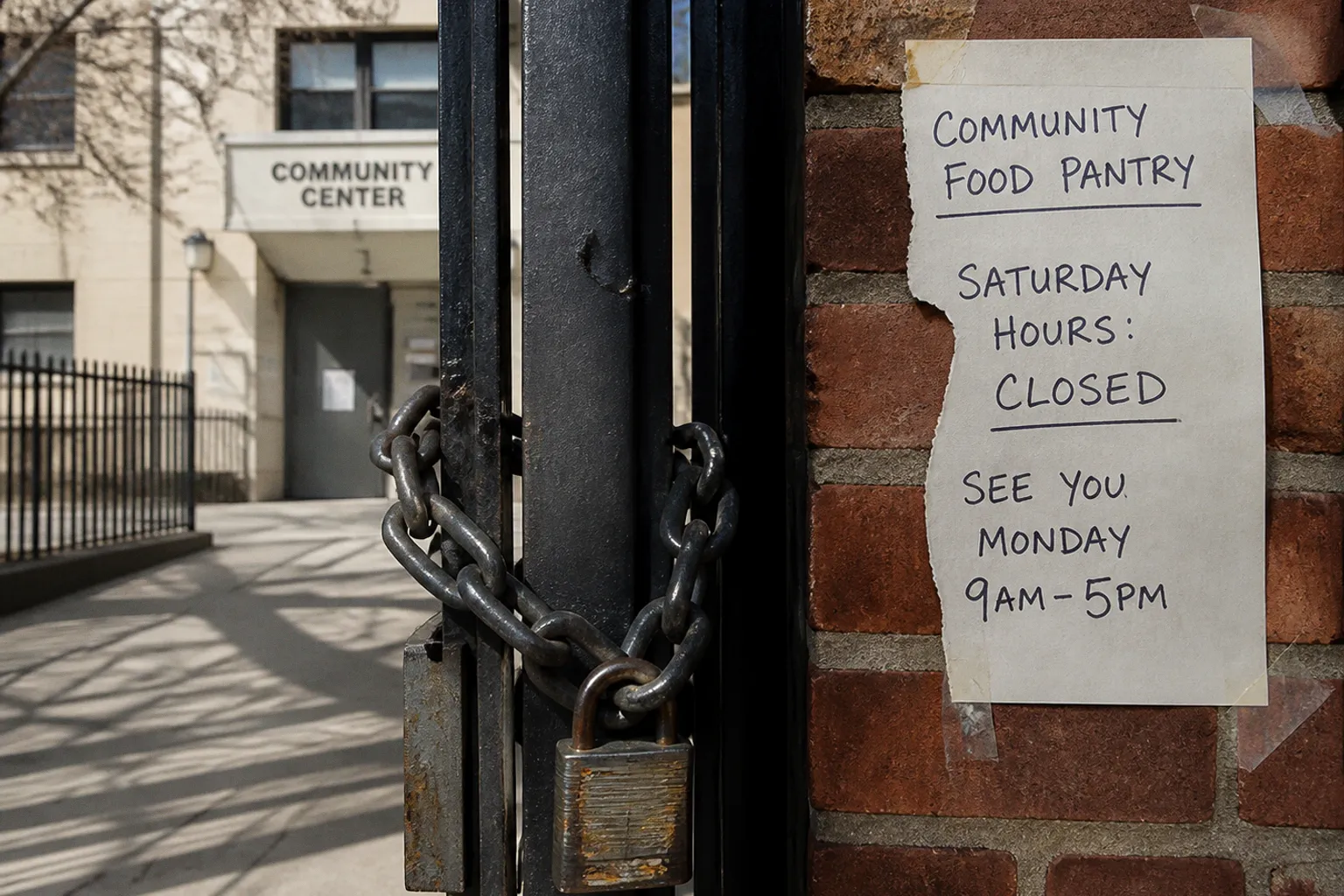
You pull up a listing on your lunch break or at ten o'clock on a Saturday morning. You find a pantry two trains away, and the screen tells you it is open from 9 a.m. to 1 p.m. on the third Saturday of every month. You make the trip. You stand on the sidewalk with a stroller and a reusable bag. The door is locked, the lights are off, or a handwritten note explains that distribution was cancelled because a volunteer driver was unavailable.
That gap—the small distance between a printed schedule and the lived experience of food access—is the central problem behind the question of nyc food pantry database reliability. For someone who needs groceries that day, an inaccurate listing is not a minor inconvenience. It can mean a wasted fare, missed work, an extra trip with children, or another evening without enough food.
The short version is that online databases are essential but deeply imperfect tools. They are the best map we have, but they are maps maintained by organizations working through volunteers, grant cycles, changing food supplies, and coordinators who may also have another job. If you are a parent, a senior, an immigrant elder, or a caseworker routing a client on a Sunday, the published hour on the screen is closer to a useful lead than a guaranteed appointment.
The Reality Gap: Why Online Directories Often Mislead
The first thing to lay out, gently but firmly, is that unreliable food pantry listings are not necessarily a moral failure by any one organization. They are a documented feature of how emergency food is distributed in New York City: through a large network of independent programs with uneven administrative capacity and rapidly changing operating conditions.
A study published in the Journal of Community Health by researchers at the CUNY Graduate School of Public Health and Health Policy found that only about half of the food pantries listed in online directories were open during the operational hours published for them. The researchers did not simply call programs and ask whether they were open. They sent trained observers into the field. In one part of the study, teams visited fifty pantry sites that appeared in Food Bank For New York City's online listings. Only twenty-five were open as expected according to the posted schedule.
The remaining sites were closed, operating at a different time, or no longer distributing food without having removed or corrected the public listing. That is effectively a one-in-two chance that a directory entry will lead to an open door at the stated time.
The finding is uncomfortable, but it needs to be interpreted accurately. It does not mean that Food Bank For New York City is indifferent to the problem, or that every listing in its database is wrong. Food Bank For NYC is one of the city's most important food providers, and maintaining a central directory for a shifting network is difficult work. The finding does show the limits of a directory that depends on organizations to report changes and on someone at the database end to process those changes.
A published pantry schedule is closer to a useful lead than a guaranteed appointment.
An online listing usually records what a program intends to do, or what it did when the record was last confirmed. It may not capture a cancelled delivery, a shortage of volunteers, a temporary relocation, a change in eligibility rules, or a pantry that has quietly paused operations. The screen gives the appearance of a fixed appointment. The service itself may remain contingent.
That distinction is especially important when people search through an emergency food program directory in New York for a weekend visit. A listing can be technically current and still fail to answer the question a person actually has: will someone be there when I arrive?
A directory is not the same thing as a service schedule
Directories flatten several different kinds of information into the same format. A program may be listed as open on Saturdays, for example, but the entry may not explain whether:
- Saturday distribution happens every week or only once a month;
- food is handed out until a set closing time or until supplies run out;
- the location is a permanent pantry, a mobile distribution, or a one-day community event;
- visitors need an appointment, referral, identification, or proof of address;
- the program has moved temporarily because of construction, weather, or a building conflict;
- the listed hours describe intake, registration, or actual food pickup.
Those distinctions matter in practice. A person who searches an NYC food assistance locator may see several nearby results and assume they are interchangeable. They are not. One may be a regular pantry with a stable schedule. Another may be a monthly distribution that serves a limited number of households. A third may remain in the database even though the organization has stopped operating at that address.
The database is therefore best treated as a starting point for a decision, not as the decision itself.
The Weekend Access Crisis: Quantifying the Disconnect
If the general reliability problem is sobering, the weekend situation is where the map truly runs out of road. The same research that produced the roughly fifty percent reliability finding also examined when pantry sessions were scheduled. Only about a quarter of the pantry sessions recorded in the analyzed online listings offered any weekend hours, while more than three-quarters took place during the standard weekday window between 9 a.m. and 5 p.m.
That schedule reflects the operating habits of many institutions, but it does not reflect the lives of the people who need the service. Hourly workers, single parents, people with rotating shifts, and households managing several jobs may have the least flexibility during the weekday hours when most distributions occur. A pantry that operates from 10 a.m. to 2 p.m. on a Wednesday may be technically accessible but functionally out of reach for someone working a shift that begins early and ends late.
The weekend should be the obvious release valve. Saturday and Sunday are often the only times a person can travel across a borough without losing wages or arranging another layer of childcare. Yet weekend listings are thinner, and the consequences of a bad listing are more severe when there are fewer alternatives nearby.
For a working parent in the Bronx or on the Lower East Side, the schedule geometry of the charitable food system can turn a search result into a dead end. A Wednesday pantry may be impossible because of work. A Saturday pantry may be the only realistic option. If that Saturday listing is outdated, there may be no practical backup.
This is why the question “are weekend hours accurate?” cannot be reduced to a technical discussion about database maintenance. Weekend availability is part of whether the emergency food system is usable at all.
Food Bank For New York City and City Harvest, two of the largest emergency food organizations in the city, publish disclaimers on their maps and locator tools indicating that distribution dates, hours, and operating schedules can change. The disclaimers are not a substitute for accurate information, but they are an honest acknowledgment of the underlying problem. A public database can offer a location and a reported schedule without being able to guarantee that the program will operate exactly as listed.
The practical implication is not that users should ignore these tools. It is that the tools need to be read with the right level of confidence. A weekday listing may be easier to verify because more staff and partner organizations are available. A weekend listing often deserves an additional call or confirmation before a person spends time and money travelling.
Weekend access is not a minor feature of a food locator. For many households, it determines whether the locator is usable.
Why the visible list can be misleading
Search tools also encourage a false sense of abundance. A map may display several points within a reasonable distance, but those points may represent different services, different eligibility requirements, or different levels of operational certainty. A marker does not tell you how many food packages remain, whether distribution has already reached capacity, or whether the program is serving people from outside its immediate neighborhood.
This is where the Plentiful app NYC accuracy question becomes more complicated than simply asking whether an app has the right address. Reservation and appointment systems can provide more current information than a static directory, but they still depend on participating organizations to confirm availability and keep their schedules connected to actual operations. The technology can reduce uncertainty without removing the conditions that create it.
Operational Realities Behind the Data Inaccuracy
It is tempting, when you first encounter these numbers, to read them as a story about laziness or disorganization. I want to push back on that reading. The unreliability of food pantry directories is downstream of a larger operational problem that has very little to do with whether a coordinator cares about keeping a webpage current.
Hunger Free America's 2018 survey of pantries and soup kitchens across the city found that roughly thirty-four percent of programs had been forced to limit their hours or turn people away because they lacked enough food, volunteers, or refrigerator space to serve everyone who arrived. When a small congregation-based pantry is operating with a handful of volunteers and receives less produce than expected, its immediate priority is distributing what it has. Updating a locator portal may come later, if there is time at all.
That is not an excuse for permanently inaccurate information. It is an explanation of why the error persists.
A pantry's actual schedule may depend on:
- whether a refrigerated truck arrives on time;
- whether a volunteer driver or intake coordinator is available;
- how much food was delivered and what kind of food it is;
- whether the program has enough storage space for the next distribution;
- whether a grant or contract supports the planned hours;
- whether the host building is available that day;
- weather, school schedules, or an unexpected neighborhood event;
- whether demand has already exceeded the supply prepared for the session.
A database wants a clean field: Saturday, 9 a.m. to 1 p.m. The pantry is managing a chain of dependencies. If one link changes, the schedule changes with it. The result is a record that may have been accurate when entered but is no longer reliable when someone searches for it.
The problem becomes more pronounced across the hundreds of smaller neighborhood programs that make up much of the city's emergency food infrastructure. A central organization can provide a directory, but it cannot personally observe every distribution. The system depends on local partners to report changes, and local partners are often the same organizations experiencing the staffing and supply pressures that cause the changes.
Demand has changed without a matching expansion in capacity
The demand side of the equation matters just as much. A 2024 spotlight report from Robin Hood and Columbia University's Poverty Tracker program found that food pantry utilization among families with children remained roughly twice as high in 2023 as it had been before the pandemic in 2019.
That finding is specific: it concerns pantry utilization among families with children. It does not establish that every pantry in the city is serving twice the total number of people it served five years earlier. The distinction matters because the pressure is uneven. Some programs may be serving far more families with children, while others may be facing different patterns of demand.
What the finding does establish is that a major group of pantry users continues to rely on emergency food at a much higher level than before the pandemic. The system is carrying sustained demand associated with housing costs, childcare, the expiration of expanded federal benefits, and the arrival of asylum-seeking families, among other pressures. Programs that were already operating with limited capacity may now have less room to absorb a late delivery, a cancelled volunteer shift, or a sudden surge in visitors.
The directories are not necessarily tracking programs that have doubled their entire volume. They are tracking a network in which utilization among families with children remained roughly twice as high as its pre-pandemic level, while the administrative systems supporting that network have not always expanded at the same pace. That is enough to create more frequent schedule changes and more uncertainty for users.
The result is a feedback loop:
1. Higher demand makes distributions more likely to fill up or change.
2. Changes are not always reported immediately.
3. Users rely on stale listings because they have no better central source.
4. Failed trips create distrust, but the need for a directory remains.
5. Community organizations compensate by maintaining informal, local knowledge.
That last layer is important. Caseworkers, tenant association organizers, faith leaders, mutual aid volunteers, and neighborhood advocates may know which sites actually distributed food last week. They are not a replacement for a public, accurate database. They are evidence that the public database is not yet doing enough on its own.
Navigating the Digital-Physical Divide for Emergency Food
So what do you actually do with this? If you are a New Yorker looking for food, or a caseworker helping someone find it, the goal is not to avoid online directories. They remain the most useful starting point. The goal is to treat them as the first step in a verification process rather than the final word.
A practical approach looks like this:
1. Call on the day of the visit. Ideally, call an hour before you plan to leave. A working phone number and a current voicemail message are useful signs that the program is still active, though neither is an absolute guarantee. Ask specifically whether distribution is happening that day, whether the posted hours still apply, and whether appointments or eligibility requirements are involved.
2. Cross-reference more than one source. Check Food Bank For NYC, City Harvest, NYC 311, and platforms such as Plentiful or Lemontree when they cover the area you need. These services may draw on overlapping but not identical information. Matching details across two sources are more reassuring than a single isolated listing.
3. Look for a recent confirmation, not only a posted schedule. A listing that shows a last-updated date, appointment availability, or a recent community notice gives you more information than a recurring schedule with no indication of when anyone last reviewed it.
4. Use community-based referrals when available. Mutual aid groups, faith communities, tenant associations, schools, libraries, and local social-service providers may have current knowledge about which distributions are operating. These channels can also help with translation, transportation, or understanding whether a program is appropriate for a particular household.
5. Keep a small rotation of reliable options. Once you have found two or three programs that have remained open across multiple visits, keep their contact information. A personal list does not eliminate uncertainty, but it reduces the need to start from scratch every time.
6. Confirm the details that directories often leave vague. Ask about registration, identification, household limits, dietary options, pickup windows, and what happens if the distribution reaches capacity. “Open” does not always mean that every person arriving during the listed period will receive food.
7. Report inaccurate information. When a listing is wrong, use the platform's feedback form or contact the relevant food bank. A correction may not help you on that particular day, but it can prevent the next person from making the same failed trip.
The pattern is simple: verify the date, verify the time, and verify what “open” means for that particular program.
| Verification step | What it costs you | What it can tell you |
|---|---|---|
| Search one directory and leave immediately | Almost no preparation | A possible location, but no meaningful confirmation |
| Compare two or more directories | Several minutes | Whether the basic address and schedule are consistent |
| Call the day of the visit | A short phone call | Whether the program expects to distribute that day |
| Ask a local community organization | Time and a relationship | Recent operational knowledge, language access, and practical context |
| Keep a personal list of reliable programs | Some initial effort | A more dependable starting point for future visits |
A cross-check does not turn an uncertain system into a guaranteed one. It improves the odds and, just as importantly, gives you a chance to discover problems before you are standing outside the building.
What advocates should ask of the system
For advocates and organizational leaders, the solution cannot depend entirely on individual users making more phone calls. That simply shifts the administrative burden onto people who may already have the least time, money, and flexibility.
The city and major food organizations need better ways to confirm whether a site is operating. Some improvements are relatively simple: recurring prompts asking programs to confirm their schedule, clear timestamps showing when a listing was last reviewed, and a visible way to mark a temporary closure. Other improvements require money and staffing, including dedicated data-entry support for small neighborhood programs that cannot absorb another reporting obligation.
A reliable database also needs to distinguish between different kinds of uncertainty. A program that operates every Saturday but may close when supplies run out should not appear identical to a program with a guaranteed appointment system. A mobile distribution should not be represented in the same way as a permanent pantry. Users need to see not only where a service is, but how stable and conditional that service is.
Most of all, weekend access should be treated as an infrastructure issue rather than a convenience feature. If people who work during the week cannot use the food system on Saturday or Sunday, then a directory with mostly weekday listings is documenting an exclusion, not solving it.
The Future of Real-Time Food Access Tracking
There is some cause for cautious optimism in the systems being built around real-time reservations and SMS-based verification. Platforms such as the Plentiful app, which has been piloted by food banks in the region, are designed around the precise failure mode described above. Rather than relying only on a static listing, these systems can allow a user to reserve a slot and a pantry to confirm availability closer to the distribution date.
That changes the relationship between the user and the database. The listing is no longer the only source of information. A reservation, confirmation message, or current appointment window provides a more direct signal that the organization expects to operate.
Still, it would be a mistake to treat technology as a complete solution. A reservation platform cannot create more food, replace a missing volunteer driver, expand refrigerator space, or guarantee that a small program will remain open during a week of unusually high demand. If the pantry's operations change and the change is not entered into the system, the digital layer can still fail.
The value of real-time tools is more modest and more practical. They move the uncertainty closer to the source of the uncertainty—the pantry itself—and farther away from the person standing on the sidewalk with a stroller. That is a meaningful improvement. It can also make the uncertainty visible: a full appointment calendar, a cancellation notice, or a message that a site is not accepting walk-ins tells a user more than an unchanged address and recurring hours.
The better future for an NYC food pantry hours update system is therefore not a single perfect map. It is a connected set of tools that can show:
- when a program last confirmed its schedule;
- whether the listed hours are recurring or one-time;
- whether appointments are required or recommended;
- whether a distribution has a capacity limit;
- whether food is available until closing or only while supplies last;
- whether a site has recently cancelled, moved, or changed its intake process;
- how users can report an error and how quickly that report is reviewed.
That kind of transparency would not remove the fragility of emergency food programs. It would stop concealing that fragility behind the appearance of a precise map.
New York City's emergency food system is a living network, and a directory is a sketch of that network rather than a photograph of it. As long as the system depends on volunteer labor, surplus donations, limited storage, and the coordination of hundreds of independent organizations, some lag between the screen and the street is inevitable.
But inevitable does not mean acceptable at its current scale. A person seeking food should not have to gamble a day's transportation money on a listing that nobody has recently confirmed. The most useful response, for now, is to combine the map with a call, a second source, and local knowledge. The longer-term response is to fund the reporting, verification, and real-time infrastructure that make those extra steps less necessary.
The question is not whether online directories are useful. They are. The question is whether they are reliable enough to carry the full weight of an emergency food system. On weekends, and especially for households with children, the answer is still no.