NYC food pantry directories: which database is actually updated?
When one of the most rigorous academic audits of New York City's emergency food network found that only half the pantries listed in a major online directory were actually open during their posted…
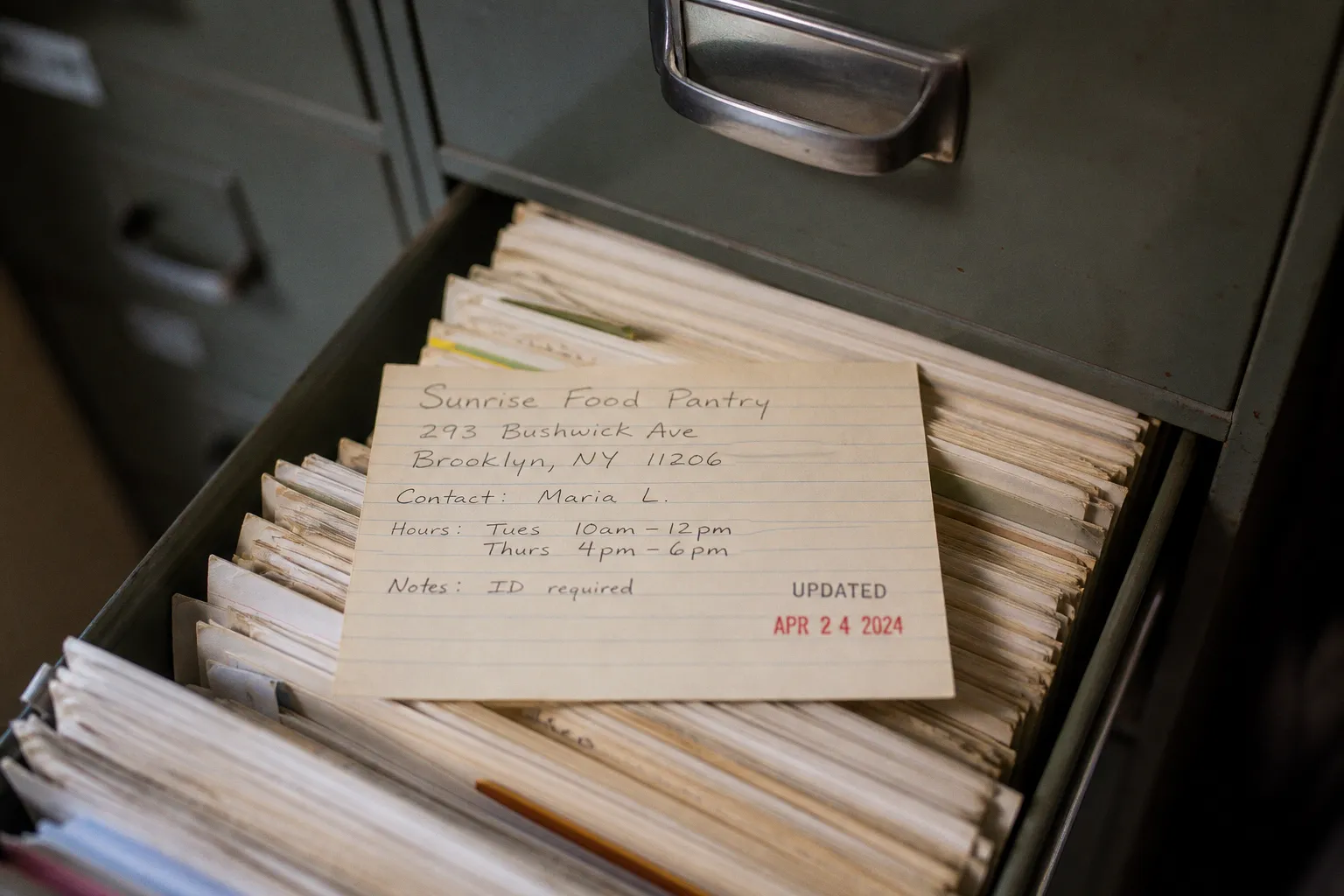
When one of the most rigorous academic audits of New York City's emergency food network found that only half the pantries listed in a major online directory were actually open during their posted hours, it exposed something every social services navigator, caseworker, and concerned neighbor already suspected at some level: the maps we rely on for hunger relief are working from stale cartography. That single finding from the Albert Einstein College of Medicine, published in 2019 and based on fieldwork conducted in 2018, has rippled outward into nearly every conversation I've had since with community-based organizations trying to feed their own neighborhoods.
The uncomfortable truth is that the nyc food pantry directory reliability question doesn't have a clean, single answer, because the directories themselves don't agree. Hunger Free America's 2018 survey of emergency food programs catalogued 741 locations across the five boroughs. The Food Bank for New York City, a major aggregator within the ecosystem, reported 663 active pantries and soup kitchens. The official FoodHelp.nyc map, meanwhile, listed only 532. Three reputable counts of the same city, each within reach of a quick Google search, each off from the others by hundreds of entries. For someone looking for a meal tonight, that gap is not academic; it's the difference between finding a hot plate at the end of a long bus ride and walking three blocks to a locked door.
The Data Gap: Why Official Maps Often Mislead
The structural problem here isn't dishonesty — it's the underlying ecology of emergency food in New York City. The vast majority of pantries and soup kitchens are operated not by large agencies but by small community stakeholders: a church basement, a mosque community room, a mutual aid collective, a senior center staffed largely by volunteers, a public housing lobby turned into a distribution point each Saturday morning. These programs live and die by volunteer capacity, by donations that arrive unevenly, by seasonal schedules, and by the personal availability of the people who unlock the door each morning. They are, in every meaningful sense, organic — and organic systems resist tidy bureaucratic indexing.
When the city's Human Resources Administration publishes a pantry on FoodHelp.nyc, that listing reflects a snapshot in time, often captured by a periodic intake survey or a one-time outreach call. But pantries change. A volunteer moves to a different borough. A grant cycle ends. The congregation that hosted Tuesday distribution decides to repurpose the fellowship hall. The mutual aid network that operated out of a community fridge pivots after a leadership change. None of these shifts generate an automated signal to update a centralized database. The directory, in effect, doesn't know what it doesn't know.
I've sat with executive directors of intermediate organizations — the so-called "backbone" nonprofits that aggregate services across neighborhoods — and heard the same refrain over and over: their intake workers spend a substantial fraction of each week calling pantries to confirm hours before sending a client across town. The directory work has been quietly outsourced from the city to the very case-management workforce that the directories were ostensibly designed to support. That hidden labor, multiplied across thousands of caseworkers, represents a real cost in an already underfunded human services ecosystem. In a city where the median caseworker salary at a community-based organization hovers near the threshold where burnout becomes attrition, every hour spent double-checking a database entry is an hour not spent on the intake conversation, the benefits enrollment, or the follow-up that actually connects a household to stable food access.
What the Numbers Actually Disagree About
A side-by-side look at the three most-cited counts makes the fragmentation easier to hold in mind:
| Source | Count of active pantries/soup kitchens | Method | Principal gap |
|---|---|---|---|
| Hunger Free America (2018 survey) | 741 | Telephone canvass of known programs | One-time snapshot; no continuous refresh |
| Food Bank for New York City directory | 663 | Aggregated partner reporting | Southern Bronx audit found roughly 50% closed during posted hours |
| FoodHelp.nyc (official city map) | 532 | HRA-maintained, agency-submitted data | Underweights small volunteer-led sites |
Three counts of the same city, no shared methodology, and no mechanism by which the discrepancies get reconciled. Each source defines "active" slightly differently — some count sites that distribute only once a month, others list only weekly operations — and none of them share their intake protocols in a way that would allow a researcher or a caseworker to normalize the numbers into a single reliable figure. For anyone building a new york social service atlas food layer, this lack of definitional consistency is the first and most stubborn obstacle.
The 50% Problem: Lessons from Academic Audits
When half the entries on the map don't match reality, the map itself becomes a barrier rather than a guide.
The Albert Einstein College of Medicine study that has become a touchstone in this conversation examined the Food Bank for New York City online directory, a resource that many smaller organizations rely on as a primary reference. Researchers called each listed pantry during its posted operating hours and recorded what they found. Roughly 50% of the time, the doors were closed. Some were closed temporarily because of a holiday or a one-off staffing gap; a meaningful number had relocated and never updated their address; and a striking share simply hadn't been open for weeks or months despite remaining in the directory.
It's important to be precise about the scope of that finding, because the study focused specifically on the southern Bronx, a part of the city with an exceptionally dense concentration of food programs and where small, volunteer-run operations are particularly common. I wouldn't want to suggest that the food help nyc map accuracy question reduces to a coin flip across all five boroughs; the picture varies substantially by neighborhood and by which directory you're consulting. Community districts with a higher share of large institutional pantries — the ones operated by established nonprofits with paid staff and regular reporting obligations — tend to hold up better under audit than districts where the landscape is dominated by faith-based and volunteer-run sites. But the headline result was sobering enough to shift how the field talks about food access data, and it predates the 2023 surge in mutual aid networks that has only made the information environment more plural and more chaotic.
What makes the 50% figure so operationally consequential is the demographic overlay. According to the 2024 Robin Hood Poverty Tracker report, 31% of adult New Yorkers — about one in three — experienced food hardship in 2023, and among families with children, that figure climbed to 44%. Within that population, a substantial share relies on the very informal, volunteer-run pantries that official maps tend to undercount or misrepresent. When half the listed sites are unreliable, the burden of verification falls on the households least equipped to absorb a wasted bus trip or a missed hourly shift.
There is a compounding dynamic here that I think gets underappreciated in policy conversations. The households facing the most acute food hardship are disproportionately the ones navigating multiple, overlapping systems of support: SNAP benefits, WIC, school meal programs, food pantry visits, and community fridge pickups, sometimes all in the same week. Each of those touchpoints has its own schedule, its own eligibility rules, and its own information channel. When one channel sends outdated information — a directory listing a pantry that closed three months ago — the cascading effect is not just a missed meal. It's a missed shift at work because the parent spent their break riding a bus to a locked door. It's a child who misses the school breakfast because the family rerouted their morning to reach a pantry that no longer operates on Thursdays. The stakes of a stale listing are not abstract.
Plentiful App and the Shift to SMS-Based Scheduling
The most reliable pantry information often doesn't live in a database at all; it lives in a text thread.
One of the most consequential innovations in this ecosystem came not from a city agency but from a coalition of community operators working through a constrained technical channel: SMS. The Plentiful App was developed by what I think of as the New York City Food Assistance Collaborative, a working group of practitioners who understood that phone trees and email blasts were failing the clients they served. Rather than building another website destined to go stale, they built a lightweight reservation and notification system on top of Twilio's messaging infrastructure.
Clients text the word FOOD to the shortcode PANTRY, which resolves to 726-879, and they're walked through an intake that supports nine languages. The system confirms their reservation, reminds them the day of, and — crucially — allows participating pantries to push real-time updates to the client directly when something changes: a volunteer canceled, a shipment is delayed, the site is closing early. That last capability is the architectural inversion that matters most. Instead of a client consulting a static map and arriving to a locked door, the information travels toward the client in the moments that matter.
This is not a small matter operationally. Plentiful reports that clients using the system save roughly an hour of wait time per visit on average, a striking figure when you consider that many of these clients are taking multiple buses, arranging childcare, or stealing time from hourly wage work to access food. The wait-time savings reflect the elimination of the "show up, line up, get turned away, find another site" cascade that defines the offline experience at so many under-resourced pantries.
What I appreciate about how the Plentiful App frames itself is that it doesn't promise to solve the broader directory problem in the abstract. It does something narrower and more honest: it serves the pantries and clients who have agreed to participate in a structured, ongoing relationship. Not every entry in any nyc food pantry locator will end up on Plentiful, and a substantial share of sites — especially the smallest volunteer-led ones — simply won't have the operational bandwidth to onboard. That's a candid limitation rather than a marketing problem, and it shapes how I advise organizations to position the tool: as a high-confidence layer rather than a comprehensive map.
There's a deeper lesson embedded in Plentiful's design that I think applies well beyond food assistance. The pantries that maintain the most accurate information are the ones where information exchange is a byproduct of the service itself, not a separate data-entry task layered on top of an already strained operation. When a client texts to confirm a reservation and the pantry texts back with a time, the information stays current because both sides need it to be current. The directories that fail are the ones that ask program operators to report updates to a central system they'll never personally consult — a data pipeline with no return flow.
Human-Verified Alternatives: The Hunter College Model
Where Plentiful offers a technological intervention, Hunter College's NYC Food Policy Center has built a human one. Since 2020, the Center has maintained Neighborhood Food Resource Guides covering all 59 community districts across New York City, a level of granularity I find genuinely impressive given how unevenly most citywide data sources treat outer-borough neighborhoods. Brooklyn Community District 5 and the Rockaways get the same coverage as the more heavily resourced Lower Manhattan districts, which is not something every "comprehensive" directory can claim.
What's distinctive about the Hunter guides is the methodology. A trained corps of more than 100 volunteers systematically calls each listed pantry, soup kitchen, and community fridge in their assigned district and verifies operating hours, eligibility rules, and what's actually on offer. The verification happens on a recurring cycle, because the guides explicitly recognize that a pantry's information is a moving target. The result is the closest thing the city has to a "verified" directory, and even the Center acknowledges that its entries are best understood as recent but not necessarily current.
For caseworkers, advocates, and residents who want a single trustworthy reference for a given neighborhood, the Hunter College guides have become an internal professional shorthand. I regularly hear navigators say they default to the Hunter PDF for the community district they're working in, then supplement it with a quick phone call to confirm before referring a client. That hybrid workflow — a verified base layer plus a final confirmation — is the realistic practical standard for food help nyc map accuracy in the current moment, and it's a workflow every reader of this publication can adopt without waiting for the city to fix the underlying data problem.
I should note one tension in the Hunter model that I don't see discussed often enough. The guides are PDFs, updated on a cycle, which means they carry the same temporal limitation as any static publication — the information is accurate on the day it was verified but drifts from reality in the weeks that follow. The Center mitigates this by maintaining an ongoing relationship with listed sites and by updating on a rolling basis, which puts them well ahead of most competing directories. But they are still, fundamentally, a verification-in-advance model, not a verification-in-real-time model. The gap between those two approaches is where most of the practical frustration for frontline workers lives, and it's a gap that no single organization — not Hunter, not Plentiful, not the city — has fully closed.
Navigating the Fragmented Landscape of NYC Food Assistance
Given everything I've walked through, what does a sensible working approach actually look like? My own practice, after several years of working alongside community-based organizations across the five boroughs, has settled into a layered strategy I'd encourage any navigator, donor, or advocate to adapt to their own context:
1. Start with the official FoodHelp.nyc map and the Hunger Free America hotline (1-866-3-HUNGRY) as a broad reference layer, while understanding that both are incomplete and that dated entries are the norm rather than the exception.
2. Layer the Hunter College Neighborhood Food Resource Guide for the specific community districts you serve, since these combine volunteer verification with borough-by-borough granularity.
3. Route same-day and time-sensitive clients toward the Plentiful App via SMS, treating it as a confirmation layer rather than a discovery layer — best for clients who can plan a visit 24 to 48 hours out.
4. Treat the caseworker's phone as the indispensable backstop: a brief call to a pantry the morning of a visit resolves questions that no database, however well-intentioned, can reliably answer.
5. Document what you find. The most useful thing individual navigators can do for the broader ecosystem is report back to the directory operators when they encounter stale listings. The Hunter guides, the Plentiful onboarding team, and even the FoodHelp.nyc maintainers all improve when the people in the field help them update the record.
For nonprofit leaders and policy advocates reading this, the strategic implication is broader than any one tool. The fragmented information environment around emergency food in New York is itself a form of legislative friction, because it slows the matching of supply — donated food, volunteer labor — with demand (households facing hardship) at precisely the moment of greatest need. The 230 million pounds of emergency food distributed across the city in 2023 — a remarkable figure that reflects the generosity of donors and the labor of community stakeholders — represents only the food that actually reached a table. Any volume lost to misrouted clients, to closing times that didn't match the listing, or to volunteer shifts that coincided with no-show arrivals is food that left the system without feeding anyone.
There's a measurement problem hiding inside that 230-million-pound figure that seldom makes it into the press releases. We know how much food enters the emergency distribution system because the Food Bank and its partner agencies track poundage with reasonable rigor. We do not know — and have no reliable way of knowing — how much of that food reaches the intended household versus how much is redirected, wasted, or rendered inaccessible by the information failures I've described throughout this piece. Closing that measurement gap would require exactly the kind of integrated, real-time data infrastructure that the ecosystem currently lacks, which means we are, in a very real sense, optimizing a system whose output we cannot fully observe.
Improving nyc food pantry directory reliability is not glamorous work, but it is some of the highest-leverage anti-hunger advocacy available in the city right now.
What I'd love to see from city government — and what I'd encourage every reader working in this space to quietly keep advocating for through budget cycles and interagency meetings — is sustained funding for the kind of ongoing verification work that Hunter College and the Food Assistance Collaborative have built on shoestring budgets. A dedicated citywide pantry-verification team, housed perhaps within the Department of Social Services or contracted through a trusted community intermediary, would transform a service ecosystem that currently moves information at the speed of postal mail into one that moves at the speed of need. That team wouldn't need to reinvent anything; the models already exist in the work Hunter and the Collaborative have done independently. What's missing is the institutional commitment to fund it at scale and to keep funding it past the first fiscal cycle.
Until that investment arrives, the honest answer to which database is actually updated is: whichever one someone called most recently. The maps will keep lagging. The text threads and the volunteer phone trees will keep filling the gap. And the work of helping a hungry neighbor find a hot meal will keep depending, as it always has in this city, on the people willing to do the small, unglamorous verification work that no algorithm has yet learned to do for them.